2 Chronicles 20 — When Song Leads the Battle
- Pr Enos Mwakalindile
- 2 days ago
- 8 min read

There are mornings when the people of God wake to the rumor of armies and feel how little their own strength can hold. The roads fill with fear. The heart begins to count enemies instead of promises. Yet in this chapter, Judah is taught a holy reversal: when danger rises, they do not begin with the sword but with seeking; not with boasting, but with bowing; not with panic, but with praise. The battle remains real, but it is no longer ultimate. Heaven speaks into the valley, and song walks where fear expected steel.

1.0 Introduction
One of the oldest temptations in crisis is to let visible pressure become final truth. We see the size of the threat, the speed of the news, the weakness of our own hands, and the soul starts to close in on itself.
That is where 2 Chronicles 20 begins. Jehoshaphat hears that a “great multitude” is coming against Judah (2 Chr 20:2). He is afraid (20:3). Scripture does not hide that. But it does show what faithful fear does next.
The heart-question of the chapter is this: What should the people of God do when the danger is real and their strength is not enough?
This text is about fear becoming worshipful dependence.
In Chronicles, courage is not raw temperament. It is the fruit of seeking the Lord (2 Chr 14:11; 15:2; 16:9; 17:4; 19:3). The turning point of the chapter is not first on the battlefield. It is in the sanctuary, when Judah learns to say, “We do not know what to do, but our eyes are on you” (2 Chr 20:12).
2.0 Historical and Literary Context
This chapter closes the Jehoshaphat narrative in 2 Chronicles 17–20. He has strengthened Judah, sent teachers through the land, and appointed judges to uphold the fear of the Lord (2 Chr 17:7–9; 19:5–11). Yet his reign has also shown cracks. He allied himself with Ahab in chapter 18 and was rebuked for helping the wicked in chapter 19 (2 Chr 19:2). So chapter 20 is not a reward for flawless kingship. It is mercy given in the path of renewed dependence.
For the Chronicler’s post-exilic audience, this story would have landed with force. They knew what it meant to be small, exposed, and politically fragile. So this chapter is not only memory; it is pastoral instruction for a wounded remnant. The way forward after collapse is not spectacle, but seeking; not nostalgia, but covenant faithfulness.
The temple stands at the center of this story because the temple stands at the center of Chronicles. It is the place of God’s name, the meeting point of prayer, repentance, and mercy (2 Chr 6:18–21, 28–30; 7:14–16). Judah’s crisis is answered there.
3.0 Walking Through the Text
3.1 When Fear Gathers the People (20:1–4)
The attack comes from Moab, Ammon, and Mount Seir (2 Chr 20:1, 10, 22–23). The threat is large enough to shake the king. But Jehoshaphat does not hide in strategy. He “set his face to seek the LORD” and proclaimed a fast (20:3). Then Judah gathered from all the cities to seek the Lord (20:4).
That movement matters. Fear could have scattered the nation into private survival. Instead, it gathers them into corporate dependence. The king leads the people not first into military mobilization but into covenant assembly. That is what a faithful son of David does in Chronicles: he turns the people Godward (cf. 2 Chr 17:4; 19:4).
3.2 When Prayer Stands on Covenant Memory (20:5–13)
Jehoshaphat stands in the house of the Lord and prays before the assembly (20:5). His prayer begins with God’s rule over “all the kingdoms of the nations” (20:6), echoing the wider biblical vision that the Lord is not a tribal deity but the sovereign King of heaven and earth (Deut 10:17; Ps 47:2, 7–8; Dan 4:34–35).
Then he remembers. God gave the land to Abraham’s offspring (20:7; Gen 12:7; 17:8). God’s name dwells in the sanctuary (20:8–9; 2 Chr 6:20). Solomon had already prayed that when disaster comes, the people may cry out toward this house and be heard (2 Chr 6:28–30). Jehoshaphat does not invent hope; he borrows it from covenant memory.
Then comes the chapter’s great confession: “We are powerless... We do not know what to do, but our eyes are on you” (20:12). This is not unbelief. It is faith stripped of pretense. It names helplessness without surrendering trust.
The closing image is tender and weighty: “all Judah” stands before the Lord, “with their little ones, their wives, and their children” (20:13). The whole future of the people is brought into prayer.
3.3 When the Spirit Reinterprets the Battle (20:14–19)
The Spirit of the Lord comes upon Jahaziel, a Levite from the sons of Asaph (20:14). That detail binds prophecy and worship together. God answers in the gathered, singing community.
The word does not minimize the danger: “Do not be afraid... because of this great multitude” (20:15). But it reframes the field: “The battle is not yours but God’s” (20:15). Judah must still go out, take position, and stand firm (20:16–17), but the decisive agency belongs to the Lord. This recalls earlier holy-war scenes where Israel is saved not by its own power but by God’s intervention (Exod 14:13–14; Deut 20:4; 1 Sam 17:47).
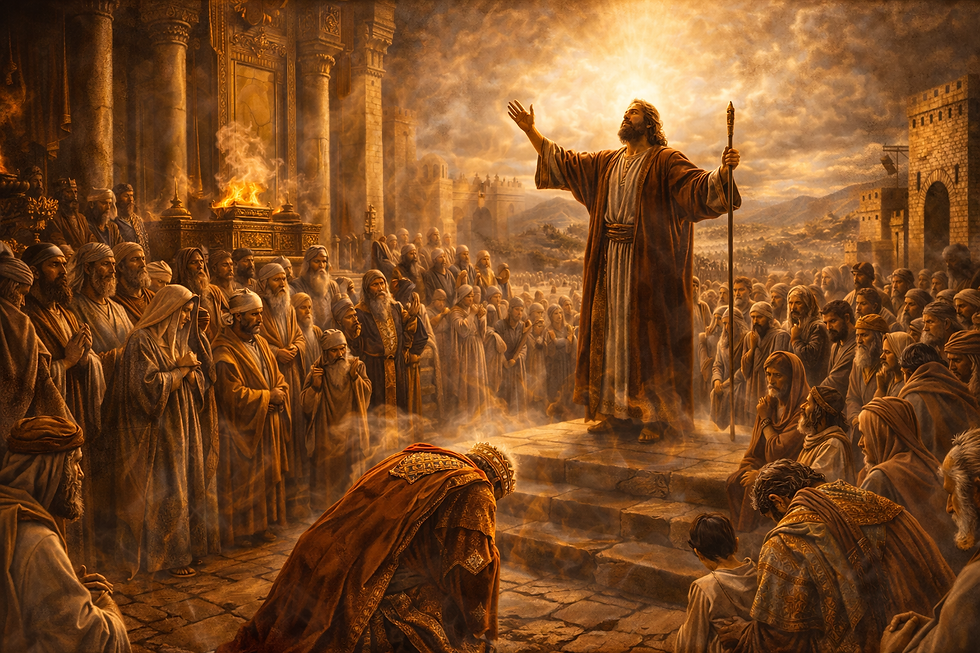
Jehoshaphat bows low, the people fall in worship, and the Levites rise to praise with a very loud voice (20:18–19). Before the enemy falls, worship rises. Praise is not delayed until the miracle is visible.
3.4 When Singers Go First (20:20–23)
Jehoshaphat exhorts the people, “Believe in the LORD your God... believe his prophets” (20:20). In Chronicles, trust in God and reception of prophetic word belong together (2 Chr 24:19–20; 36:15–16).
Then the king appoints singers to go before the army, declaring, “Give thanks to the LORD, for his steadfast love endures forever” (20:21). That refrain is temple language (1 Chr 16:34, 41; 2 Chr 5:13; 7:3, 6). Judah marches as though covenant mercy is more decisive than military mass.
And when they begin to sing and praise, the Lord sets ambushes against the enemy coalition (20:22). Moab and Ammon turn against Mount Seir, then destroy one another (20:23). The hostile alliance collapses under divine judgment. What Judah could not master, God undoes.
3.5 When the Valley Receives a New Name (20:24–30)
Judah finds the battlefield already won (20:24). Then they gather spoil for three days because it is abundant (20:25). On the fourth day they assemble in the Valley of Beracah—Valley of Blessing—because there they blessed the Lord (20:26).
Chronicles loves this kind of naming. Memory is anchored in place. The valley of threat becomes the valley of blessing because God has rewritten what that place means.
The people return to Jerusalem with joy, with instruments, and with procession to the house of the Lord (20:27–28). The story began with alarm and ends in liturgy. It also ends with a familiar Chronicler word: rest. “God gave him rest all around” (20:30; cf. 1 Chr 22:9, 18; 2 Chr 14:6–7; 15:15). Rest is not self-made security. It is covenant gift.
3.6 When the Ending Refuses Easy Heroics (20:31–37)
Jehoshaphat is commended as a good king, yet the high places remain, and the people have not fully set their hearts on the God of their fathers (20:32–33). Then another compromised alliance appears, this time with Ahaziah of Israel (20:35–37). A prophetic word announces judgment, and the ships are wrecked.
This sober ending is faithful to the theology of Chronicles. Reform and incompleteness often stand close together. A king may seek the Lord truly and still remain vulnerable to compromise. The chapter will not let us rest in admiration of Jehoshaphat. It teaches us to rest in the Lord who saved him.

4.0 Theological Reflection
4.1 Seeking the Lord Is the Great Dividing Line
In Chronicles, kings are measured by whether they seek the Lord or forsake Him (2 Chr 12:14; 15:2; 16:9; 26:5). Here, seeking includes fasting, assembling, praying, bowing, listening, and obeying. It is not vague spirituality. It is covenant posture.
4.2 The Temple Is the Place Where Helplessness Learns to Pray
Jehoshaphat’s prayer stands in continuity with Solomon’s temple prayer (2 Chr 6:28–30). The temple is where divine name, communal need, and promised mercy meet. Later Scripture carries this hope forward: the Lord’s true dwelling with His people reaches its fullness in the Messiah, who speaks of His own body as the temple (John 2:19–21), and in whom God’s presence is no longer shadowed but embodied (Col 1:19; 2:9).
4.3 Song of Praise Is a Form of Holy Trust
The singers at the front are not performing mood-management. They are confessing reality: the Lord’s steadfast love endures forever (2 Chr 20:21; Ps 136). Praise becomes warfare because it declares where sovereignty truly lies.
4.4 Rest Comes from God’s Victory, Not Human Mastery
The chapter ends with rest because the Lord fought for Judah (20:29–30). This anticipates the deeper rest given through the true Son of David, who defeats the enemies beneath all visible enemies—sin, death, and the powers of darkness (Matt 11:28–30; Col 2:15; Heb 4:8–10).
5.0 Life Application
Bring fear quickly into prayer instead of letting it roam the heart unanswered.
Gather with God’s people in crisis; private panic shrinks the soul, but shared worship enlarges trust.
Pray with remembered Scripture, not only with raw emotion.
Say the truth before God: “We do not know what to do,” and keep going until it becomes, “our eyes are on you.”
Put praise in front of panic; let worship lead where anxiety wants to rule.
Refuse alliances that demand spiritual compromise, even after seasons of blessing.
Build habits of temple-shaped life—prayer, confession, praise, obedience—before the day of trouble arrives.
6.0 Reflection Questions
What threat has become too large in my imagination because God has become too small in my attention?
What would it mean, concretely, for my household or church to seek the Lord together?
Which promises of God need to be remembered again in prayer?
Where has praise been delayed until after deliverance, rather than offered in faith before it?
What compromise keeps returning even after genuine experiences of grace?
7.0 Response Prayer
O Lord, God of our fathers,when fear comes with a loud voice,teach us to answer with seeking.When we do not know what to do,keep our eyes from falling to the ground;lift them toward You.
Make Your people a praying people again.Let song rise before panic hardens.Turn our valleys of dread into valleys of blessing.Break every alliance with compromise.Give us humble hearts, listening ears, and steadfast worship.And in the greater Son of David,lead us into the rest that no enemy can steal.Amen.
8.0 Window into What Comes Next
This victory is bright, but it is not the end of Judah’s testing. Soon the story turns from Jehoshaphat’s gathered prayer to Jehoram’s darkening reign. The lamp of David still burns, but the wind around it grows harsher.
9.0 Bibliography
Dillard, Raymond B. 2 Chronicles. Word Biblical Commentary 15. Waco, TX: Word, 1987.A detailed exegetical commentary, especially strong on literary structure, Chronicler theology, and close reading of narrative patterns.
Japhet, Sara. I & II Chronicles: A Commentary. Old Testament Library. Louisville: Westminster John Knox, 1993.Especially valuable for the Chronicler’s ideology, vocabulary, and the theological shaping of Judah’s history for a post-exilic audience.
Pratt, Richard L., Jr. 1 & 2 Chronicles. Focus on the Bible. Fearn: Christian Focus, 1998.Helpful for tracing the pastoral logic of Chronicles and showing how temple, kingship, and repentance function together.
Sailhamer, John. First and Second Chronicles. Everyman’s Bible Commentary. Chicago: Moody Press, 1983.Useful for the broad theological flow of Chronicles, especially its emphasis on Davidic hope, temple centrality, and God’s faithfulness in history.
Selman, Martin J. 2 Chronicles. Tyndale Old Testament Commentaries. Downers Grove, IL: InterVarsity Press, 1994.A concise but perceptive guide to the text, with strong attention to canonical context, theology, and the Chronicler’s pastoral aims.


Comments