
Analysis of 1 Chronicles 27: Beams Beneath the Kingdom - How God Builds Peace Through Ordered Service
- Pr Enos Mwakalindile
- 5 days ago
- 9 min read

Updated: 4 days ago
Not every holy chapter thunders. Some stand like cedar beams hidden above the eye—silent, load-bearing, patient. In 1 Chronicles 27 the kingdom is not bleeding in battle or blazing in revival. It is being arranged. Names are given. duties assigned. storehouses watched. sons prepared. And the Chronicler whispers to a ruined people: peace is not kept by noise alone, but by ordered faithfulness beneath the roof.
1.0 Introduction
There is a kind of unfaithfulness that does not look dramatic. It does not arrive with idols on high hills or open rebellion at the gate. It comes more quietly: neglected structures, unshared burdens, unguarded resources, unprepared successors, numbers trusted more than God, and peace enjoyed without asking what holds it up.
That is the heart-question of 1 Chronicles 27: What kind of order can bear the weight of God’s peace?
This text is about rest becoming responsible stewardship.
For the Chronicler, a kingdom is not sustained by charisma alone. Worship requires structure. blessing requires wise guardianship. promise requires patient preparation. The chapter teaches a postexilic community—and teaches us—that holy life is not only a matter of fire on the altar, but also of faithful hands beneath the beams.
2.0 Historical and Literary Context
First Chronicles 27 stands in David’s long season of preparation near the end of the book (1 Chr 22–29). The surrounding chapters arrange Levites, priests, singers, gatekeepers, treasurers, and officers for the house of the LORD (1 Chr 23–26). Chapter 27 widens the frame. The kingdom outside the sanctuary must also be ordered: military divisions, tribal leaders, royal stewards, and counselors all receive their place.
That matters because Chronicles never treats worship as an isolated religious corner. The house of the LORD is the center, but covenant life radiates outward into the whole life of the people (cf. Deut 12:5–14; 1 Chr 22:19; 2 Chr 29:3–11). David is therefore remembered not only as conqueror and psalmist, but as a king who prepares a people, an administration, and a future in which worship may endure.
This is especially important for the Chronicler’s audience. They are living after judgment, after exile, after the collapse of throne and temple. For such a people, restoration cannot survive on nostalgia alone. It needs ordered faithfulness. It needs memory given form.
The chapter also deliberately carries an old wound: the census of 1 Chronicles 21. In other words, even while listing divisions and leaders, the Chronicler refuses to let order become self-trust. Numbering can serve stewardship, but numbering can also become a rival liturgy of security (1 Chr 21:1–8). That tension lies near the center of the chapter.
3.0 Walking Through 1 Chronicles 27
When Peace Still Keeps Watch (1 Chronicles 27:1–15)
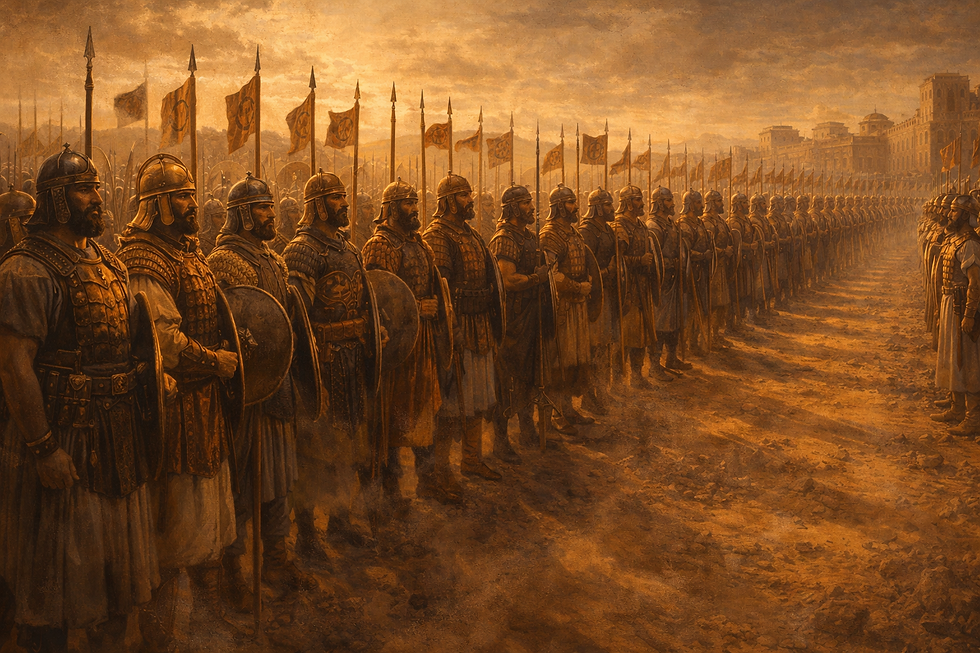
The chapter begins with twelve monthly divisions of military service, each numbering twenty-four thousand under appointed commanders. The pattern is careful, rotational, and stable. This is not wartime panic. It is ordered readiness.
The literary effect matters. After long narratives of conflict, David’s kingdom is now shown as structured rather than scrambling. The sword is still sheathed at the nation’s side, but it is no longer the chapter’s drama. The Chronicler is showing what peace looks like when it learns discipline.
This is not militarism. It is stewardship of a settled people. Israel had known wilderness disorder, tribal fragmentation, and the instability of the judges (Judg 21:25). Under David, strength is gathered and ordered. The leaders named here are linked to the mighty men traditions of earlier chapters (cf. 1 Chr 11), suggesting that courage has now matured into durable service.
There is also a quiet theology of shared burden. David does not centralize every duty into one anxious center. Responsibility is distributed. Each month has its servants. Each division has its leader. In this sense, the chapter echoes the wisdom of delegated care seen earlier in Israel’s story, when burdens were shared for the sake of justice and endurance (Exod 18:17–23; Num 11:16–17).
So the lesson is simple but weighty: peace is not passive. Rest under God does not abolish watchfulness. It trains it.
When Counting Meets a Covenant Boundary (1 Chronicles 27:16–24)
The focus then shifts to tribal leaders. Heads are named over Israel’s tribes, but the list slows down at verses 23–24. David did not count those under twenty years old, “for the LORD had promised to make Israel as many as the stars of heaven” (1 Chr 27:23; cf. Gen 15:5; 22:17; 26:4). Joab began to count, but did not finish, because wrath came upon Israel, and the total was not entered in the chronicles of King David (1 Chr 27:24; cf. 1 Chr 21:14).
This interruption is the chapter’s theological hinge. The Chronicler allows lists, but he places a boundary around counting. Why? Because Israel is not finally secured by measurable strength. The people are not David’s possession to quantify at will. They are the LORD’s covenant people, multiplied by promise before they were ever managed by policy.
That appeal to the stars of heaven is not decorative language. It reaches back to Abraham and reminds the reader that Israel’s existence rests on God’s word, not on royal control. The same God who numbers the stars (Ps 147:4) does not permit His people to be numbered in a spirit of self-exalting security.
This does not mean all counting is sinful. Moses took censuses under divine instruction for ordering camp, warfare, and inheritance (Num 1:1–3; 26:1–4). The issue is not administration itself, but the heart beneath it. In Chronicles, one may arrange the kingdom and still forget the King. One may measure strength and quietly shift trust from promise to visible power.
That is why the chapter is so pastorally sharp. It affirms structure while exposing pride. It honors stewardship while warning against control. Even David, the beloved king, is remembered here as a forgiven ruler whose authority has limits.
When Storehouses Become Sacred Space (1 Chronicles 27:25–31)
The next scene turns to the king’s treasuries, storehouses, fields, vineyards, olive and sycamore groves, herds, camels, donkeys, and flocks. Overseers are appointed over each domain. The list has the feel of geography under governance—lowland and hill country, field and barn, vine and animal, all brought into named oversight.
At first glance, this seems merely practical. But Chronicles never wastes such detail. In this book, the ordering of life around the sanctuary is itself theological. The temple may be the covenant center, but the land around it must also be stewarded in covenant ways. The same David who appoints singers and gatekeepers appoints keepers of vineyards and storehouses (cf. 1 Chr 23–26).
This reveals a profoundly biblical truth: worship and daily labor are not finally severed. Fields and flocks are not spiritually neutral. Oil, wine, produce, and livestock all belong within the moral world of God’s reign (Deut 8:7–18; Prov 3:9–10). Prosperity, if not governed, curdles into pride. Resources, if not stewarded, become occasions for self-glory or neglect.
There is even an Eden-like undertone here. Humanity was first placed in God’s world to serve and guard what belonged to Him (Gen 2:15). Israel’s king, at his best, does not own the land absolutely; he oversees it under the greater kingship of God (Lev 25:23). David’s administrative order thus becomes a kind of royal stewardship beneath divine lordship.
For a postexilic people with fragile resources and reduced strength, this mattered deeply. Rebuilding life with God would require not only prayers and festivals, but barns, fields, treasuries, honesty, and disciplined provision.
When Wisdom Sits Beside the Throne (1 Chronicles 27:32–34)
The chapter ends with David’s inner circle: Jonathan the counselor and scribe, Jehiel with the king’s sons, Ahithophel the counselor, Hushai the king’s friend, then Jehoiada, Abiathar, and Joab. The kingdom closes here not with spectacle, but with proximity—who stands near the throne and what kind of wisdom surrounds it.
This ending is fitting. Structures alone do not keep a kingdom faithful. Thrones need truthful voices nearby. David’s own story had already shown how counsel can heal or destroy, steady or betray (2 Sam 15:12, 31–37; 16:20–23; 17:1–14). So Chronicles closes the chapter by naming the ecology of leadership: counsel, friendship, priestly presence, care for sons, and military command.
Even “the king’s friend” carries theological beauty. Leadership is not meant to be armored loneliness. Covenant life requires relationships close enough to tell the truth. The mention of the king’s sons also tilts the chapter toward succession. David is not merely ruling the present; he is preparing the future (cf. 1 Chr 28:5–10).
This, too, is one of the hidden beams of peace: wise nearness, truthful counsel, and the forming of those who will inherit the work.
4.0 Theological Reflection
4.1 Worship Radiates into the Whole Shape of Life
Chronicles insists that the temple is central, but never solitary. Holy worship must send order outward into leadership, economics, protection, and communal care. The chapter’s lists teach that liturgy without faithful structures becomes fragile. In Scripture, love for God is never meant to remain trapped in the sanctuary; it must shape the life surrounding the sanctuary (Deut 6:4–9; Jas 1:27).
4.2 Promise Must Govern Administration
The reference to the stars of heaven places covenant promise above visible scale. That is the chapter’s necessary warning. There is a way to manage faithfully, and there is a way to count as though the future belongs to human control. The people of God may use numbers, but they must never worship them. Promise must interpret administration, not the other way around (Gen 15:5; 1 Chr 21:1–8; Ps 20:7).
4.3 Davidic Leadership Prepares What It May Not Finish
Here David appears not mainly as warrior, but as preparer. He orders servants, structures, resources, and relationships for a future he will not fully inhabit. This pattern runs through Scripture: Moses leads to the edge, David prepares the house, prophets sow hope across ruins (Deut 34:4–5; 1 Chr 22:5; Hag 2:3–9). God often teaches His servants to labor beyond the horizon of their own lifetime.
This also creates longing for the greater Son of David, who does not merely prepare the dwelling of God but becomes, in His own person, the true meeting place of God and humanity (John 1:14; 2:19–21).
4.4 Hidden Faithfulness Is Not Lesser Faithfulness
Much of this chapter concerns work that would never feel dramatic: rotations, oversight, property management, advisory presence. Yet the Chronicler treats such things as load-bearing. This is a needed correction for every generation tempted to admire only what is public. In the kingdom of God, unseen service often keeps the visible testimony standing (Luke 16:10; 1 Cor 12:22–24).
5.0 Life Application
Examine the hidden beams of your life or ministry: structures, finances, accountability, succession, and shared responsibilities.
Do not confuse peace with permission to drift. Calm seasons are often the best seasons for ordering what matters.
Measure carefully, but trust promise more than numbers. Statistics can serve wisdom; they must never become your savior.
Treat resources as entrusted realities under God, not trophies of personal achievement.
Keep wise, truthful people near the center of your life. Every leader needs friends, counselors, and those who can speak hard truth.
Prepare others for what comes after you. Faithful leadership is not only what you build, but whom you ready.
Honor ordinary service. Quiet stewardship may be one of the holiest forms of obedience in a noisy age.
6.0 Reflection Questions
What hidden structure in my life is quietly weakening while the visible parts still look strong?
Where am I tempted to trust numbers, scale, or visible strength more than the promise of God?
What practical area of stewardship most needs repentance and reordering right now?
Who is near enough to my “throne” to tell me the truth?
Am I building only for my season, or am I preparing others for the future?
7.0 Response Prayer
Lord of the house,Lord of the field,Lord of the storehouse and the song,You see what stands in publicand what holds in secret.
Teach us to honor the hidden beams.Save us from the pride that counts strengthand forgets the stars of Your promise.Give us clean hands for stewardship,steady hearts in seasons of peace,and humble wisdom that knows this people is Yours.
Set truthful voices near us.Raise faithful servants among us.Teach us to prepare what we may never finish,and to love obedience more than applause.
Where our structures are cracked, repair them.Where our motives are proud, humble them.Where our peace has made us careless, awaken us.And let every field, room, ledger, and giftbe gathered again beneath Your reign.
Through the true Son of David,who is greater than the house we build,Amen.
8.0 Window into What Comes Next
The beams are now in place. Commanders, stewards, counselors, and sons stand where David has arranged them. But structure is only preparation. In the next chapter, David will gather the leaders and speak plainly about the house of God, the chosen son, and the charge that must outlive him. The quiet architecture of service will open into a public summons: not merely to admire the kingdom, but to give oneself for the building of the house.
9.0 Bibliography
Dillard, Raymond B. 2 Chronicles. Word Biblical Commentary 15. Waco, TX: Word Books, 1987. A concise evangelical commentary, especially useful for tracing the Chronicler’s theological patterns of retribution, reform, and temple-centered history.
Japhet, Sara. I and II Chronicles: A Commentary. Old Testament Library. Louisville: Westminster John Knox, 1993. A major scholarly treatment of Chronicles with sustained attention to literary shaping, ideology, and the Chronicler’s distinct retelling of Israel’s past.
Klein, Ralph W. 1 Chronicles: A Commentary. Hermeneia. Minneapolis: Fortress Press, 2006. Particularly strong on textual detail, structure, and the theological logic of lists, offices, and royal organization in 1 Chronicles.
Knoppers, Gary N. I Chronicles 10–29: A New Translation with Introduction and Commentary. Anchor Yale Bible 12A. New Haven: Yale University Press, 2004. Rich in historical, lexical, and intertextual analysis; especially valuable for understanding Davidic administration and the Chronicler’s reuse of earlier traditions.
Sailhamer, John. First and Second Chronicles. Everyman’s Bible Commentary. Chicago: Moody Press, 1983. Clear and accessible, with helpful canonical sensitivity and concise summaries of the book’s theological movement.
Williamson, H. G. M. 1 and 2 Chronicles. New Century Bible Commentary. Grand Rapids: Eerdmans, 1982. A dependable classic for the structure, postexilic setting, and editorial purpose of Chronicles as theological history for a restored community.


Comments