
Analysis of 1 Samuel 10 — Oil, Signs, and a Spirit‑Rushed Heart: When the Anointed One Hides Among the Baggage
- Pr Enos Mwakalindile
- 1 day ago
- 15 min read
When oil runs down on an unsure head, signs unfold like stepping‑stones, a timid heart feels the rush of the Spirit, and Israel’s first king stands taller than all—yet chooses, for a moment, to disappear among the bags.

1.0 Introduction — When a Hidden Call Becomes Public
We left Saul on the outskirts of the city, standing still as Samuel raised his hand and said, “Stand still, that I may make known to you the word of God” (9:27).
1 Samuel 10 shows what that word looks like when it lands.
The chapter begins in intimate secrecy: oil on the head, a kiss of commissioning, three strange signs, and the promise of a Spirit‑wrought transformation. It ends in noisy publicity: a national assembly at Mizpah, the casting of lots, the shout, “Long live the king!”—and the awkward discovery that the chosen man is hiding among the baggage.
If 1 Samuel 9 told the story of how God quietly sent Saul to Samuel, chapter 10 tells how God marks Saul out for the people—and how the people respond when confronted with the king they demanded. The tensions of chapters 8–9 are all still here. Yahweh has named the request for a king a rejection (8:7; 10:19), yet he personally chooses, anoints, and equips that king. Saul receives “another heart,” yet he hesitates. The Spirit rushes upon him, yet the chapter ends with “worthless men” despising him and refusing tribute (10:9–10, 27).
Here we witness a delicate moment in Israel’s history: the dawn of the monarchy as both gift and question, both grace and judgment. The God who was rejected as King (8:7) does not abandon his people; instead, he walks with them into the future they insisted on, placing even this contested institution under his word and Spirit.

2.0 Historical and Literary Context — Between Secret Anointing and Public Acclamation
2.1 1 Samuel 9–10:16 as a Unit in Saul’s Rise
Most interpreters see 1 Samuel 9:1–10:16 as a single narrative unit: Saul’s search for donkeys, his encounter with Samuel, his secret anointing, and the confirming signs that follow.
This block likely stems from an older “Saul narrative” that remembered his rise in relatively positive tones—emphasizing divine choice, prophetic confirmation, and military leadership—later woven into the larger prophetic and Deuteronomistic history of Samuel (McCarter 1980, 1–30). Within that broader history, our chapter sits at a hinge: it completes the hidden, private side of Saul’s call (10:1–16) and then moves toward the first public recognition of his kingship (10:17–27).
2.2 Nagid, Not Yet Melek
In 10:1 Samuel declares that Yahweh has anointed Saul as nagid over his “heritage” or “inheritance” (naḥălâ). The term nagid (“leader,” “prince”) accents function more than status; it often describes one set apart to rule under God’s authority rather than over against it. Only later will Saul be consistently called melek (“king”).
The vocabulary already hints at a tension: Israel will have a king, but he is to be a steward of Yahweh’s inheritance, not an owner of it. The “rights” or “charter” of kingship that Samuel writes and lays before Yahweh in 10:25 frames this new office not as autonomous power but as a vocation accountable to the covenant God.
2.3 Mizpah and the Deuteronomistic Frame
The assembly at Mizpah in 10:17–25 recalls earlier gatherings there in Judges and in Samuel (Judg 20; 1 Sam 7). Mizpah is a place where Israel repents, hears prophetic rebuke, and makes corporate decisions.
The speech in 10:18–19 has a strongly Deuteronomistic flavor: Yahweh reminds the people of his saving acts—“who brought up Israel out of Egypt and delivered you from the hand of the Egyptians and from the hand of all the kingdoms that were oppressing you”—and charges them with rejecting him as their savior by insisting on a king. Many scholars therefore see 10:17–27 as part of a prophetic history that interpreted the rise of the monarchy with both suspicion and hope, later incorporated into the broader Deuteronomistic History from Deuteronomy through Kings (McCarter 1984, 1–19).
In that history, 1 Samuel 8–12 functions as a carefully framed dossier on the origins of kingship, holding together Yahweh’s critique of the people’s motives with his gracious willingness to guide and constrain the institution they demanded.

3.0 Walking Through the Text — Oil, Signs, Spirit, and Baggage
3.1 10:1–8 — Anointing, Kiss, and Three Signs of Confirmation
The chapter opens with an unannounced act:
“Then Samuel took a flask of oil, and poured it on his head, and kissed him, and said, ‘Has not the LORD anointed you to be prince over his heritage?’” (10:1).
Oil on the head marks Saul as set apart for royal service. The kiss is not sentimental but covenantal—a sign of loyalty and perhaps of adoption into a new role. The question “Has not the LORD anointed you…?” is rhetorical; through Samuel’s act, Yahweh himself has claimed Saul.
Samuel then promises three signs that will meet Saul “today” as he returns home (10:2–7). Each sign touches a different layer of Saul’s life:
At Rachel’s tomb two men will tell him that the donkeys have been found and that his father is now anxious for him (10:2). The practical worry that drove Saul’s journey is resolved, and the center of concern shifts from livestock to son. The reference to Rachel recalls the beloved mother of Benjamin, subtly tying Saul’s call to the grief and hope of his ancestral line.
Near the oak of Tabor he will meet three men going up to God at Bethel, carrying kids, bread, and wine; they will greet him and give him two loaves (10:3–4). This sign links Saul’s future with Israel’s worship. He is not only a tribal leader but one drawn into the pilgrimage of the people of God. Receiving bread from worshipers anticipates his role as one who must nourish the people in faithfulness.
At Gibeath‑ha‑Elohim he will encounter a band of prophets coming down from the high place with musical instruments, prophesying (10:5). “Then the Spirit of the LORD will rush upon you, and you will prophesy with them and be turned into another man” (10:6). This is the climax: royal calling will be sealed by charismatic empowerment. Saul is not left to rule by personality alone; he is promised a new capacity of heart shaped by the Spirit.
Samuel’s final instruction in this sequence is striking: “Now when these signs meet you, do what your hand finds to do, for God is with you” (10:7). The signs are not an end in themselves; they are preparation for active obedience. Yet, immediately, Saul is also told to go down to Gilgal and wait seven days for Samuel to come and offer sacrifices and tell him what to do (10:8). This anticipates the crisis in 13:8–14, when Saul’s failure to wait becomes the grounds for the rejection of his dynasty.
Already here, then, the pattern is set: the king must act boldly because “God is with you,” but he must also wait obediently for the prophet’s word. The tension between initiative and obedience will haunt Saul’s story.
3.2 10:9–13 — Another Heart and a New Proverb
Verse 9 is as compact as it is profound:
“When he turned his back to leave Samuel, God gave him another heart; and all these signs came to pass that day.”
The giving of “another heart” (lēb ’aḥēr) does not mean that Saul ceases to be himself. It means that God equips him inwardly for a new role. In the Old Testament, the “heart” is the seat of thought, courage, and will. Saul is being reshaped at the level of desire and capacity for the vocation he is about to carry.
When he meets the prophetic band, “the Spirit of God rushed upon him, and he prophesied among them” (10:10). The verb “rushed upon” (ṣālaḥ) is used elsewhere of the charismatic empowerment of judges like Samson. The same Spirit who once clothed deliverers now marks Israel’s first king.
The onlookers are baffled. They know Saul as the son of Kish, not as a prophet. Their question—“What has come over the son of Kish? Is Saul also among the prophets?” (10:11–12)—becomes a proverb. It captures the surprise of grace: the God who chooses leaders is free to act beyond the expectations of lineage and reputation.
Yet the narrative is also cautious. After the prophesying, Saul goes “to the high place” (10:13), but we are not told of any speech or act of worship. The promise of transformation is real, but its long‑term shape remains open.
3.3 10:14–16 — Concealed Calling
Back home, Saul’s uncle asks the ordinary question, “Where did you go?” Saul answers truthfully about the donkeys and his visit to Samuel (10:14–15). When pressed, he adds that Samuel told them the donkeys had been found—but “about the matter of the kingdom, of which Samuel had spoken, he did not tell him anything” (10:16).
His silence may be modesty; it may also be uncertainty. Saul has been anointed, kissed, promised signs, given another heart, and swept up in prophetic ecstasy. But in the family courtyard, under the gaze of an uncle who knows him as “the son of Kish,” he is not yet ready to say, “I have been chosen as king.”
The text lets us feel the gap between divine call and self‑understanding. Sometimes the word of God comes faster than our ability to confess it aloud.
3.4 10:17–19 — A King and a Rejected Savior
The scene shifts back to Mizpah, where Samuel summons “all the people of Israel” before Yahweh (10:17). His speech is severe:
“Thus says the LORD, the God of Israel, ‘I brought up Israel out of Egypt… but you have today rejected your God, who saves you from all your calamities and your distresses; and you have said to him, ‘No, but set a king over us’” (10:18–19).
The word “rejected” echoes 8:7 and anticipates the later rejection of Saul (15:23, 26). The people’s desire for a king is framed not as a simple political reform but as a theological affront: they are trading a history of divine deliverance for the visible reassurance of a human throne.
Still, Yahweh does not withdraw. After naming their rejection, he instructs them through Samuel to present themselves by tribes and clans (10:19). The very God they have rejected now presides over the casting of lots that reveals his chosen king.
3.5 10:20–24 — Lots, Height, and Hiding Among the Baggage
The process is slow and solemn. First the tribe of Benjamin is taken, then the clan of Matri, then Saul son of Kish (10:20–21). The people are learning, step by step, that the king comes from the least of the tribes, just as Saul himself earlier protested (9:21).
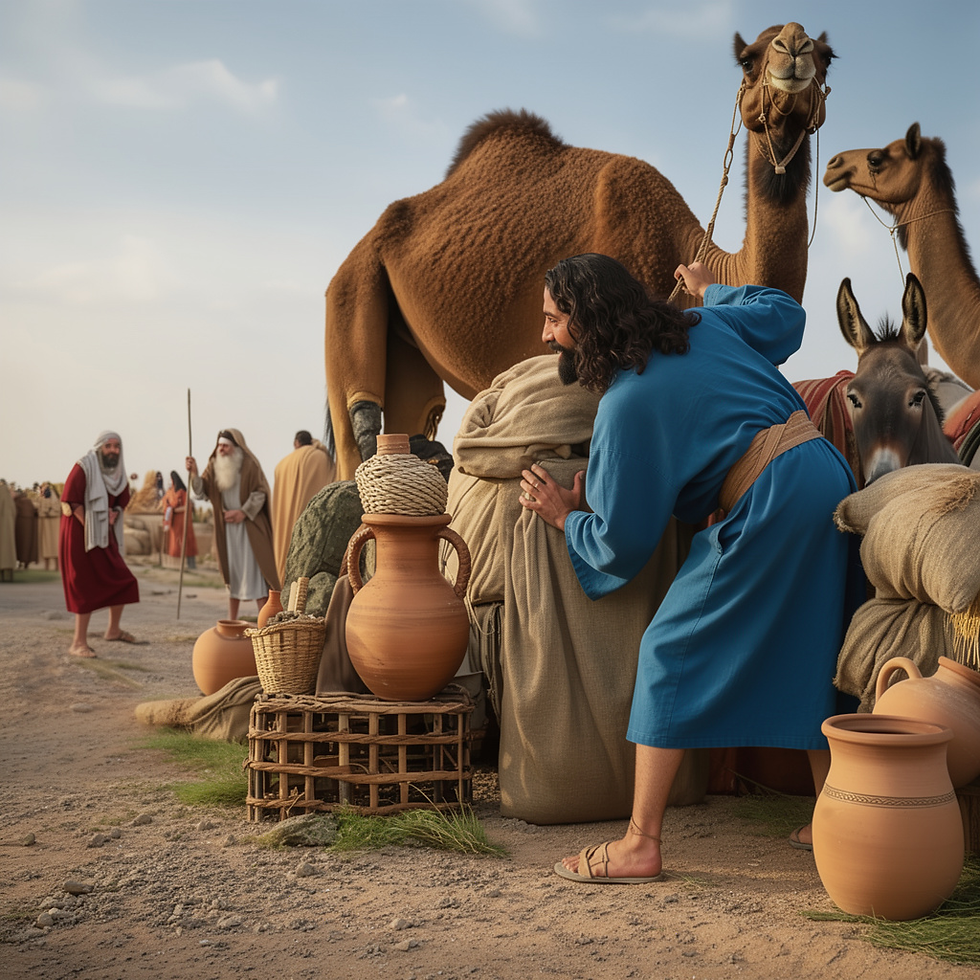
Yet when the lot falls on Saul, he is nowhere to be seen. They inquire of Yahweh again: “Is there still a man to come?” The answer is painfully ironic: “Behold, he has hidden himself among the baggage” (10:22).
The one who has been anointed in secret, given another heart, confirmed by signs, and chosen publicly by lot is hiding among the piles of equipment. His reluctance may be humility, fear, or both. The narrative does not psychologize him; it simply shows a king who must be dragged from the shadows by divine disclosure.
When they bring him out, however, he stands “taller than any of the people from his shoulders upward” (10:23). Samuel presents him: “Do you see him whom the LORD has chosen? There is none like him among all the people” (10:24). The people respond with the traditional acclamation, “Long live the king!”
Thus the chapter holds together two images: Saul the hesitant fugitive among the bags and Saul the impressive figure who visually fulfills the people’s desire for a king “like all the nations” (8:5, 20). The external match between their expectations and his appearance sits uneasily alongside his internal hesitation.
3.6 10:25–27 — A Charter, Loyal Hearts, and Contemptuous Voices
Samuel then “told the people the rights and duties of the kingship, and he wrote them in a book and laid it up before the LORD” (10:25). The mishpat ha‑melukhah (“charter” or “regulation of kingship”) echoes God’s earlier warning about how a king will “take” in 8:11–18. Whether 10:25 refers to Deuteronomy 17:14–20, to a now‑lost written summary, or to the material already spoken in chapter 8, the point is clear: the king’s authority is defined and constrained by a word that stands before God.
Israel’s story does not move from theocracy to monarchy so much as to a new form of theocracy, in which king and people alike stand under the written will of Yahweh.
The people return home, but Saul does not go alone. “Valiant men whose hearts God had touched” go with him (10:26). The same God who gave Saul another heart now stirs other hearts to support him.
Yet not all hearts respond this way. “Worthless men” (bĕnê beliyya‘al) sneer, “How can this man save us?” They despise him and bring him no tribute (10:27). The chapter’s last line is simple and suggestive: “But he kept silent.”
His silence may be prudence rather than passivity. The narrative will show in chapter 11 that when the crisis with Nahash the Ammonite breaks, Saul will not remain silent; the Spirit will rush upon him and he will act decisively. For now, the newly anointed king begins his reign not by crushing dissent but by bearing it.

4.0 Theological Reflection — Grace, Ambiguity, and the Beginnings of Royal Power
4.1 A God Who Grants Requests Without Abandoning His People
1 Samuel 10 portrays a God who allows his people to move in a direction that grieves him yet refuses to walk away. Israel’s desire for a king is rooted in fear and comparison (8:19–20). Yahweh names it as rejection, but then he himself chooses, anoints, equips, and regulates the king they demanded.
The pattern is deeply pastoral: God may sometimes let us have what we insist on, yet even then he works within our choices to rescue, discipline, and guide.
4.2 Anointing, Spirit, and the Mystery of “Another Heart”
Saul’s experience raises both hope and warning. He is genuinely anointed; the Spirit genuinely rushes upon him; he genuinely receives “another heart.” Yet the wider narrative will show that such experiences do not guarantee lifelong faithfulness.
Spiritual empowerment is real, but it is not mechanical. The same Spirit who equips can also depart (16:14). The call is to live in ongoing responsiveness, not to rest on a single moment of ecstasy.
4.3 Public Calling and Private Hesitation
The picture of Saul hiding among the baggage is painfully relatable. Many of us know what it is to sense that God is calling us into a task we did not choose—to speak, to lead, to reconcile, to serve—and to want to disappear among the nearest piles of “stuff.”
Scripture does not mock this hesitation, but it does not romanticize it either. Saul’s reluctance is understandable, yet his story will show how unresolved insecurity can open the door to later fear‑driven disobedience. The call is to expose our fear to God’s light before it hardens into rebellion.
4.4 Kingship Under the Word
The “charter of kingship” in 10:25 is a crucial moment in Israel’s story of God’s rule. Here power is written down, bounded, and placed “before the LORD,” as if to say: the throne in Jerusalem, when it comes, is at best a signpost to a deeper reality. The king is not the origin of justice but is called to embody the covenant justice already revealed in Torah; his task is to serve the purposes of the true King rather than to invent his own.
Read this way, 1 Samuel 10 fits the wider biblical claim that Israel’s God is already King and that human rulers, at their best, are advance echoes of his coming reign. In a world—including our own—where leaders often imagine that charisma and popularity license them to reshape reality, this chapter quietly insists that the living God speaks first and last. Even Spirit‑gifted leaders must have their authority continually measured, corrected, and renewed by the written and spoken word of the covenant‑keeping God.
4.5 Hearts Touched, Hearts Hardened
Finally, 1 Samuel 10 reminds us that whenever God raises up a new work, responses are divided. Some hearts are “touched” by God to walk with Saul; others harden into contempt.
The text does not promise that a genuine call will automatically win universal support. It does, however, suggest that God himself will awaken faithful companions for those he calls—and that the proper response to contempt is not always immediate retaliation, but often patient endurance until the right moment to act.

5.0 Life Application — When You Want to Hide in the Baggage
5.1 Receiving a Calling You Did Not Seek
Perhaps you find yourself in a role you never aspired to: a leadership position at work, unexpected responsibility in church, a family situation where others now look to you. Like Saul, you did not go out to seek a crown; you were just looking for “lost donkeys”—trying to solve practical problems.
This chapter invites you to see that God may be at work precisely there. The ordinary tasks that fill your days may be the very path along which he is quietly leading you into a calling you never would have written for yourself.
5.2 Asking for God’s “Another Heart”
You may feel keenly aware that your current heart—the patterns of thought, courage, and desire you live with—seems unequal to what lies ahead. Rather than pretending confidence you do not feel, you can ask for what God gave Saul: another heart for this season.
This does not erase your personality; it deepens it with courage, wisdom, and love that you do not generate on your own. Pray for the Spirit to rush upon you not once, but again and again, shaping your inner life for the work in front of you.
5.3 Naming Your “Baggage”
Saul’s hiding place has become a metaphor. The “baggage” in which we hide may be fear of failure, shame from past mistakes, a sense of unworthiness, or even a comfortable routine we do not want disturbed.
Take time to name what your “baggage” is. Where do you instinctively retreat when God’s call feels too exposed? Bring that place into prayer. Ask that when God calls your name, you will be willing to step out—not because you trust yourself, but because you trust the One who has already seen you hiding and still chooses you.
5.4 Leading Under Scripture
When God entrusts us with any measure of authority—in family, church, or workplace—he is not giving us a private throne but asking us to represent his kingdom. 1 Samuel 10 pictures this in the “charter” laid before the LORD: power is written down, bounded, and kept under God’s gaze. For us, that charter is Scripture—God’s story of rescue, judgment, and renewal—which means our decisions and influence are to be shaped by the crucified and risen King, not by fear, ambition, or the urge to fit in.
To work under God’s authority, mediated through Scripture, is to return again and again to the Word so that our plans are re‑formed rather than simply approved. We invite the text to search our motives and re‑aim our leadership toward the life of the new creation—justice, mercy, holiness, and hope. In this way authority ceases to be something we clutch and becomes a calling to wise, self‑giving service, echoing readings of Scripture as the sweeping narrative of God’s kingdom within which the church is called to improvise faithfully (Wright, 27–30).
5.5 Handling Contempt with Holy Restraint
You may already have tasted the sting of “worthless men” or women—voices that say, “How can this person save us?” Saul’s first response was silence. There are times to answer critics, but there are also times when the most faithful act is to entrust your reputation to God and allow your obedience, over time, to answer.
Ask for discernment to know when to keep silence and when to speak, when to endure and when to confront.
6.0 Reflection Questions
Where in your life do you presently carry some measure of authority—in family, church, or workplace—and how does 1 Samuel 10 invite you to see that role not as a private throne but as a place to represent God’s kingdom?
What might “another heart” look like for you in this season if it included a deeper desire to live and lead under Scripture as your charter, rather than under your own instincts or the pressure to fit in?
If you were to name your “baggage”—the fears, ambitions, wounds, or habits that make you hide from God’s call or cling to control—what would you call it, and how might you bring it into the searching light of God’s Word in honest prayer?
In what ways have you seen Scripture not just approve but actually re‑form your plans, decisions, and use of influence? Where might God be inviting you to let his new‑creation life—justice, mercy, holiness, and hope—shape your next act of leadership?
Who around you has recently been entrusted with new responsibility, and how could you come alongside them as a kingdom companion—praying Scripture with them, encouraging them to lead under God’s authority, and supporting them when they feel like hiding among the baggage?
7.0 Response Prayer
God of oil, Scripture, and Spirit,
You brought your people out of Egyptand have walked with them through every distress.Yet we confess we still reach for visible thrones and safe‑looking titlesinstead of trusting youand seeing every task of leadershipas a signpost of your kingdom.
Thank you that you do not abandon us,that you still choose and anoint,still give “another heart,”and still speak through Scriptureas the living charter of your people.
Where we stand before new responsibilityand feel like slipping away among the baggage,call us by name.Pour your oil on our fears,rush upon us by your Spirit,and give us hearts shaped by your courage,your compassion,and your new‑creation purposes.
Teach us to lead under your Word, never above it.Let your Scriptures search our motivesand re‑form our planstoward justice, mercy, holiness, and hope.Remind us that we are stewards, not owners,servants, not sovereigns,representatives of a kingdom that is not our own.
When opposition or contempt arises,grant us grace to know when to keep silenceand when to speak,trusting that you see and judge rightly.Make our homes, churches, and workplacessmall outposts of your reign,where authority is exercised as wise, self‑giving serviceunder the lordship of the crucified and risen King.
We pray in the name of Jesus,anointed in the Jordan,walking by the Spirit,opening the Scriptures to his disciples,refusing worldly crowns,and now reigning as the true King.
Amen.
8.0 Window into the Next Chapter
The first king has been anointed, the proverb has been born, the baggage has been left behind, and a small company of valiant men walks home with Saul. Yet some voices still scoff, “How can this man save us?”
In the next chapter, those words will be tested.
1 Samuel 11 — A Spirit‑Roused King and a Rescued City: When Fear Becomes the Furnace of Courage.A brutal enemy will threaten Jabesh‑gilead, the Spirit of God will rush upon Saul once more, and the hesitant man from Benjamin will lead Israel into deliverance and renewed covenant joy.
9.0 Bibliography
Baldwin, Joyce G. 1 and 2 Samuel. Tyndale Old Testament Commentaries. Leicester: Inter‑Varsity, 1988.
Firth, David G. 1 & 2 Samuel: A Kingdom Comes – An Introduction and Study Guide. T&T Clark Study Guides to the Old Testament. London: T&T Clark, 2019.
McCarter, P. Kyle Jr. I Samuel: A New Translation with Introduction, Notes and Commentary. Anchor Bible 8. Garden City, NY: Doubleday, 1980.
McCarter, P. Kyle Jr. II Samuel: A New Translation with Introduction, Notes and Commentary. Anchor Bible 9. Garden City, NY: Doubleday, 1984.
Nichol, Francis D., ed. The Seventh‑day Adventist Bible Commentary. Vol. 2. Washington, DC: Review and Herald, 1954.
Wright, N. T. Scripture and the Authority of God. Rev. ed. London: SPCK, 2013.


Comments