
Analysis of Ruth 2 — Fields of Favor: Gleaning Grace under the Wings of the Redeemer
- Pr Enos Mwakalindile
- Dec 3, 2025
- 15 min read

On the edges of a field, a foreign widow discovers that the God who shelters under his wings often does so through the kindness of his people.

Ruth 2 is a chapter that begins with simple survival and ends with astonished praise.
At the close of chapter 1, Naomi and Ruth arrived in Bethlehem “at the beginning of barley harvest” (Ruth 1:22). There is grain in the fields, but nothing yet on their table. They are two widows with no land of their own, dependent on the gleaning provisions of Torah (Lev 19:9–10; 23:22; Deut 24:19–22) and the mercy of landowners.
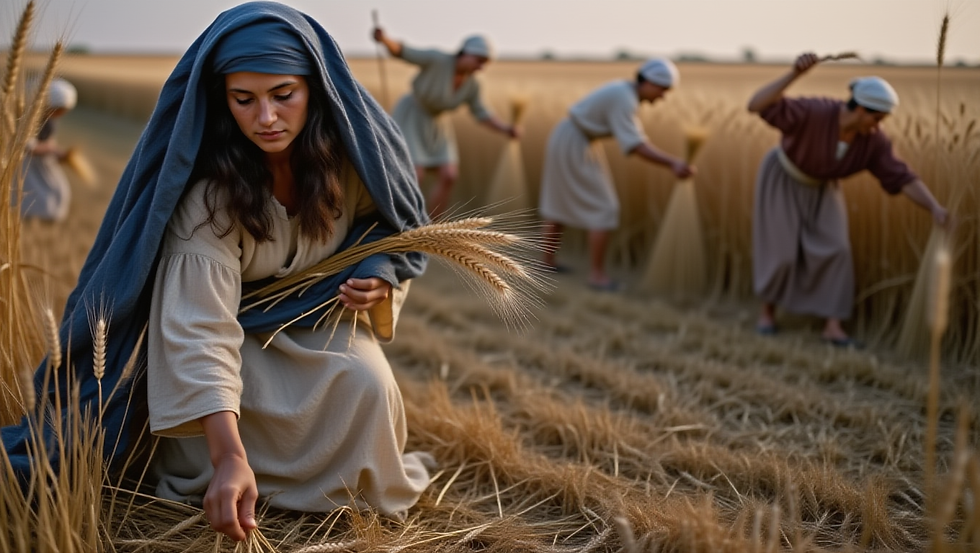
Ruth takes the initiative: “Let me go to the field and glean among the ears of grain after him in whose sight I shall find favor” (2:2). She steps into the vulnerable position of a foreign woman gleaning behind male workers—a place open to neglect, harassment, or worse. But the narrator quietly notes that “her chance chanced upon” the field of Boaz (2:3), a relative of Elimelech who is “a worthy man” (2:1). Behind ordinary chance, a deeper providence is at work (Block 1999, 641–43; Sakenfeld 1999, 35–38).
In this chapter we watch:
Ruth’s courageous diligence as she gleans from morning till evening.
Boaz’s generous and protective hesed as he blesses, safeguards, and supplies her.
Naomi’s bitter theology beginning to thaw as she recognizes God’s kindness to the living and the dead (2:20).
Ruth 1 showed us lament and loyalty on the road of return. Ruth 2 shows us what it looks like when that loyalty meets a field of grace and the quiet hand of God. If Ruth 1 took us from famine to the first hint of harvest, Ruth 2 takes us from bare gleaning to overflowing provision and from naming God as the source of calamity (1:21) to blessing him as the giver of kindness (2:20).
This chapter invites questions like:
How does God’s providence work through “coincidence” and daily work?
What does it mean for a powerful man to use his strength as Boaz does—for protection, not exploitation?
How do ordinary practices of generosity and hospitality become part of God’s redemptive story?
Ruth 2 unfolds like a warm spring day in Bethlehem: what begins in vulnerability becomes, by evening, a basket full of grain and a house full of hope.
2.0 Historical and Literary Context — Gleaning, Go’el, and the God of the Margins
2.1 Gleaning and God’s Social Imagination
The practice of gleaning underlies this entire chapter. Torah commanded landowners not to reap to the very edges of their fields or strip their vineyards bare, but to leave margins for “the poor and the sojourner” (Lev 19:9–10; 23:22; Deut 24:19–22). Israel’s God built social protection for the vulnerable into the agricultural calendar.
Ruth, a poor foreign widow, stands at the intersection of those laws. She is precisely the kind of person YHWH had in mind. Ruth 2 shows us what happens when a landowner not only obeys the letter of these commands but embodies their generous spirit (Block 1999, 640–44; Nielsen 1997, 56–59).
2.2 Boaz the “Worthy Man” and Go’el Potential
Boaz is introduced as a “worthy man” (gibbor chayil) of the clan of Elimelech (2:1). The phrase can imply wealth, social standing, and moral excellence. Later, Ruth herself will be called a “worthy woman” (eshet chayil) (3:11), pairing their character descriptions (Nielsen 1997, 55–56; Lau 2010, 142–46).
Boaz is also a relative close enough to be a potential go’el, a “redeemer” or “kinsman‑redeemer,” who can act to restore family land and name (2:20; Lev 25:25; Deut 25:5–10). Ruth 2 does not yet explicitly invoke legal procedures, but it quietly positions Boaz as someone who could play a redemptive role for Naomi’s household.
2.3 Structure of Ruth 2
Commentators commonly outline Ruth 2 as a series of scenes that move between field and home (Block 1999, 641–49; Sakenfeld 1999, 35–49; Webb 2015, 248–54):
Introduction of Boaz and Ruth’s Initiative to Glean (2:1–3) — Boaz is named; Ruth volunteers to glean and “happens” into his field.
Boaz Arrives and Inquires about the Stranger (2:4–7) — Boaz greets his workers with a blessing and hears Ruth’s story from his foreman.
Boaz’s First Conversation with Ruth (2:8–13) — He offers protection, access to water, and a blessing under YHWH’s wings; Ruth responds with humility.
Midday Meal and Extra Provision (2:14–17) — Ruth eats with the workers and gleans an ephah of barley.
Naomi’s Surprised Joy and Recognition of the Redeemer (2:18–22) — Ruth reports to Naomi; Naomi blesses God and identifies Boaz as a near relative.
A Season of Ongoing Provision (2:23) — Ruth continues gleaning through the barley and wheat harvests, “living with her mother‑in‑law.”
The chapter’s rhythm alternates between public space (the field, with Boaz’s workers) and private space (Naomi’s home). In the field, favor is given. At home, that favor is interpreted theologically.
2.4 Literary Links: Wings, Worth, and Hidden Providence
Several motifs in Ruth 2 will echo in later chapters:
“Wings” — Boaz blesses Ruth for seeking refuge under YHWH’s wings (2:12); in chapter 3, Ruth will ask Boaz to spread his “wing/garment” over her as redeemer (3:9).
“Worthy” (chayil) — Boaz is a “worthy man” (2:1); Ruth will be called a “worthy woman” (3:11), pairing them as matching partners in character.
Providential “chance” — The phrase in 2:3 literally reads “her chance chanced upon” Boaz’s field, a Hebrew way of drawing attention to providence disguised as coincidence (Block 1999, 642).
These threads tie Ruth 2 into the wider tapestry of the book. As Tim Mackie observes, Ruth’s story invites us to see God’s kingdom arriving not on the battlefield but in the field, not through a judge’s sword but through barley, blessing, and boundary‑crossing hesed (BibleProject 2023).
3.0 Walking Through the Text — Gleaning Grace in a Worthy Man’s Field
3.1 Ruth 2:1–3 — Ruth’s Initiative and “By Chance” in Boaz’s Field
“Now Naomi had a kinsman of her husband, a worthy man of the clan of Elimelech, whose name was Boaz.” (2:1)
The narrator briefly introduces Boaz, then shifts back to Naomi and Ruth’s immediate problem: food. Ruth speaks up: “Let me go to the field and glean among the ears of grain after him in whose sight I shall find favor” (2:2). Naomi agrees: “Go, my daughter.”
Ruth’s words show both initiative and dependence. She does not wait passively; she sets out to work. Yet she knows that safety and success depend on finding “favor” (chen) with a landowner. As a Moabite widow, she is doubly vulnerable.
Then the narrator adds a crucial line: “She set out and went and gleaned in the field after the reapers, and as it happened, her chance chanced upon the field belonging to Boaz” (2:3, author’s translation). The doubled phrase “her chance chanced” is almost playful, nudging the reader to see that this is not mere luck. The God who “visited his people” with bread (1:6) is now guiding Ruth’s steps to the right field.
3.2 Ruth 2:4–7 — Boaz’s Blessing and Ruth’s Reputation
“And behold, Boaz came from Bethlehem. And he said to the reapers, ‘The LORD be with you!’ And they answered, ‘The LORD bless you.’” (2:4)
Boaz enters the scene with a greeting that reveals his character. The first words we hear from him are a blessing in YHWH’s name. His workers respond in kind. The atmosphere in his field is one where the divine name is spoken not as a slogan but as a shared blessing.
Boaz notices the newcomer: “Whose young woman is this?” (2:5). The foreman explains that she is “the young Moabite woman” who came back with Naomi from Moab (2:6). He reports that Ruth asked permission to glean and has been working steadily “from early morning until now, except for a short rest” (2:7). Ruth’s diligence and humility have already created a reputation.
Here, as Lau notes, social identities are in view: Ruth is marked as a Moabite, yet her behavior and connection to Naomi commend her to Boaz (Lau 2010, 148–52). The question “Whose…?” also underscores issues of belonging and protection: under whose care and authority does this vulnerable woman stand?
3.3 Ruth 2:8–13 — Under Boaz’s Protection and YHWH’s Wings
“Then Boaz said to Ruth, ‘Now, listen, my daughter, do not go to glean in another field or leave this one, but keep close to my young women… Have I not charged the young men not to touch you?’” (2:8–9)
Boaz addresses Ruth directly, calling her “my daughter,” a term of kindness and generational difference. He grants her:
Security of place — She is to stay in his field, behind his female workers.
Protection from harassment — The young men are explicitly commanded not to “touch” her.
Access to water — She may drink from the jars drawn by the men.
In a context where gleaners could be easily mistreated, Boaz proactively creates a safe and honoring space for Ruth. He enacts Torah’s care for the vulnerable with generous specificity (Sakenfeld 1999, 40–42).
Ruth falls on her face and asks, “Why have I found favor in your eyes, that you should take notice of me, since I am a foreigner?” (2:10). Boaz answers that he has heard of all she has done for Naomi—leaving father, mother, and homeland to come to a people she did not know before (2:11). Ruth’s hesed toward Naomi has reached Boaz’s ears.
Then Boaz speaks a profound blessing:
“May the LORD repay you for what you have done, and may you receive a full reward from the LORD, the God of Israel, under whose wings you have come to seek refuge!” (2:12)
The image of taking refuge under God’s wings evokes a mother bird sheltering her young (cf. Ps 17:8; 36:7; 57:1). Boaz interprets Ruth’s decision to cling to Naomi and YHWH (1:16–17) as an act of trust in YHWH’s protective care. As readers, we can see that Boaz himself is becoming part of the answer to his own prayer: he will be one of the “wings” through which God shelters Ruth.
Ruth responds with gratitude, acknowledging that Boaz has comforted her and spoken kindly to her, “though I am not even like one of your servant girls” (2:13). She remains painfully aware of her outsider status even as she receives favor.
3.4 Ruth 2:14–17 — Table Fellowship and Overflowing Provision
At mealtime, Boaz invites Ruth to come and eat with the reapers: “Come here and eat some bread and dip your morsel in the wine” (2:14). She sits beside the reapers, not at a distance. Boaz personally serves her roasted grain until she is satisfied and has leftovers.
After the meal, Boaz quietly instructs his young men:
Let her glean even among the sheaves (the already gathered bundles).
Do not reproach her.
Pull out some stalks from the bundles and leave them for her to glean.
Boaz moves beyond minimum compliance with the gleaning law into gracious abundance. Ruth, for her part, works hard. By evening, she beats out what she has gathered—about an ephah of barley (2:17), roughly 20–30 liters, an astonishing amount for a single day’s gleaning. This is no mere subsistence; it is superabundant generosity (Block 1999, 647–48).
3.5 Ruth 2:18–20 — Naomi’s Theology Begins to Soften
“And she took it up and went into the city. Her mother‑in‑law saw what she had gleaned. She also brought out and gave her what food she had left over after being satisfied.” (2:18)
Ruth brings home a full measure of grain and the leftover cooked food from lunch. Naomi, stunned, asks, “Where did you glean today? Where have you worked? Blessed be the man who took notice of you” (2:19). The quantity alone signals that someone has been extraordinarily kind.
When Ruth names Boaz, Naomi’s response is explosive: “May he be blessed by the LORD, whose kindness has not forsaken the living or the dead!” (2:20). Opinions differ on whether “whose kindness” refers to Boaz’s or the LORD’s, but the ambiguity may be intentional: God’s hesed is being expressed through Boaz’s actions (Sakenfeld 1999, 46–47; Webb 2015, 252).
Naomi then reveals a crucial piece of information: “The man is a close relative of ours, one of our redeemers” (2:20). For the first time, the language of go’el enters the story. Naomi’s perception shifts from pure bitterness (1:20–21) to recognition that God’s kindness extends “to the living and the dead”—to her present need and to Elimelech’s family line.
3.6 Ruth 2:21–23 — A Season of Safe Work and Growing Hope
Ruth reports that Boaz has invited her to stay close to his young men until they have finished all his harvest (2:21). Naomi affirms this as good: “It is good, my daughter, that you go out with his young women, lest in another field you be assaulted” (2:22). The danger in other fields is real; Boaz’s field is a place of safety.
The chapter concludes: “So she kept close to the young women of Boaz, gleaning until the end of the barley and wheat harvests. And she lived with her mother‑in‑law” (2:23). Time passes. Ruth continues in the same field, under Boaz’s protection, through a whole season of harvests. Daily bread is secured. Naomi is no longer alone. The air is thick with possibilities not yet realized.
Ruth 2 ends not with dramatic resolution but with a sustained season of grace. God’s kindness is no longer only an idea; it is barley on the table and safety in the fields.
4.0 Theological Reflection — Providence, Power, and the Practice of Hesed
4.1 Providence in the Ordinary
The phrase “her chance chanced upon” Boaz’s field (2:3) carries a gentle irony. From one angle, Ruth’s arrival in that field is incidental. From another, it is the outworking of divine providence. Ruth 2 shows us a God who directs steps without erasing human agency. Ruth decides to glean; Boaz decides to bless; God weaves their decisions into a story of redemption (Block 1999, 642–43).
This accords with N. T. Wright’s picture of Scripture as a drama in which God, the playwright, allows his actors real improvisation while guiding the overall story toward new creation. Ruth improvises faithfully; Boaz improvises generously; God’s purposes move forward, quietly but surely.
4.2 Boaz’s Use of Power: A Redeemer in Advance
Boaz models a redeemed use of power. As a wealthy, male landowner in patriarchal Israel, he has immense social leverage. He could ignore Ruth, exploit her vulnerability, or keep to bare legal obligation. Instead he:
Sees her and inquires about her story.
Speaks kindly and calls her “my daughter.”
Creates practical protections against harassment.
Shares table fellowship and personally serves her.
Instructs his workers to ensure abundant provision.
Boaz’s actions echo the character of Israel’s God: protector of widows, lover of foreigners, defender of the poor (Deut 10:18–19; Ps 146:7–9). As BibleProject notes, Boaz is a walking embodiment of Torah in this chapter, showing what it looks like when God’s covenant instructions shape daily business practices (BibleProject 2023).
4.3 Ruth’s Ongoing Hesed: Faithfulness in the Field
Ruth’s courage did not end with her vow in chapter 1. In Ruth 2, her hesed takes the form of sweaty, back‑bending labor. She works “from early morning until now” (2:7). She bows low before Boaz, acknowledges her status as a foreigner, and yet persists in her role as provider for Naomi.
Her faith is not primarily expressed in dramatic worship experiences but in faithfully showing up in the field day after day. In Tim Mackie’s language, Ruth is an “image of God” in the mundane, reflecting God’s faithful love by the way she sticks with Naomi and embraces hard work for her sake.
4.4 Naomi’s Theological Journey: From Bitter Accusation to Blessed Praise
Naomi’s words in chapter 1 named God as the source of her emptiness. In chapter 2, when Boaz’s kindness appears, she blesses both Boaz and YHWH: “Blessed be he by the LORD, whose kindness has not forsaken the living or the dead!” (2:20).
Naomi’s theology is not suddenly tidy. She does not erase her past pain. But she begins to see that the same God she accused of bringing calamity can also be the God whose hesed has not gone away. Her journey suggests that faith can include both honest complaint and renewed praise as God’s kindness breaks into our grief in unexpected ways (Sakenfeld 1999, 46–48; Nielsen 1997, 59–61).
4.5 Hesed as Mission: Welcoming the Outsider into the Story
Ruth 2 continues to emphasize Ruth’s identity as “the Moabite” (2:2, 6, 21). Yet in Boaz’s field, the boundaries of Israel’s community are quietly redrawn. A Moabite widow is treated with honor, invited to the table, and blessed in YHWH’s name.
This anticipates the wider biblical mission in which Israel is called to be a light to the nations and in which the nations are drawn into Israel’s story. As Wright and others stress, the inclusion of figures like Ruth in the Messiah’s genealogy signals that God’s plan has always been to create a family from all nations through Israel’s faithful remnant (Wright 2012). Ruth 2 gives us a down‑to‑earth scene of that mission: a field, a foreigner, and a faithful Israelite who makes space for her.

5.0 Life Application — Fields, Workplaces, and Houses of Bread Today
5.1 Seeing God at Work in “Coincidences”
Ruth went out hoping to find favor somewhere; “as it happened” she landed in Boaz’s field. Many of us know what it is to look back and realize that what felt like random turns were actually pivot points of grace.
Ruth 2 encourages us to:
Hold our daily choices seriously—showing up, working diligently, taking initiative—as places where God often meets us.
Look back over our own stories and notice the “Boaz fields” where we “just happened” to land in the right place at the right time.
Thank God not only for dramatic miracles but for quiet providences: the job we almost didn’t apply for, the church we almost didn’t visit, the person who “just happened” to notice us.
5.2 Using Power and Resources Like Boaz
Most of us have some field—a workplace, home, ministry, or social sphere—where we have more power than others. Boaz invites us to ask:
Who are the “Ruths” on the edges of my field—immigrants, single parents, widows, the unemployed, those in low‑paying roles?
How can I create safety, welcome, and tangible provision for them?
Are my business practices shaped by God’s concern for the poor, or only by efficiency and profit?
Boaz’s example challenges Christian leaders to make their “fields” places where God’s hesed is experienced in concrete policies and personal kindness.
5.3 Honoring the Work of Caregivers and Providers
Ruth’s gleaning is an act of caregiving as much as labor. She is providing for Naomi. Today, many Ruths work quietly—often in low‑status jobs or unpaid roles—caring for elders, children, or ill family members.
The church is called to recognize and honor such work, not as background noise but as central to God’s mission. We reflect God’s heart when we:
Support caregivers with practical help and financial assistance where possible.
Speak blessing over those whose daily work is hidden but essential.
Resist measuring worth only by visible success or income.
5.4 Becoming Communities of Table Fellowship and Safety
Boaz invites Ruth to eat at his table and ensures her protection among his workers. In a world where many feel unsafe or unseen, Christian communities are called to mirror that pattern.
Practically, that might mean:
Creating church spaces where those on the margins—refugees, the poor, those from stigmatized backgrounds—are genuinely welcomed and not merely tolerated.
Ensuring robust safeguarding policies to protect the vulnerable from abuse.
Structuring communal meals and small groups to include those who might otherwise eat alone.
Ruth 2 imagines a “house of bread” where the bread is truly shared.
5.5 Encouraging the Naomis Among Us
Finally, Ruth 2 reminds us that some in our communities are mid‑journey like Naomi—still carrying grief, but beginning to glimpse kindness again. We can:
Celebrate with them every “ephah of barley” moment—every small sign of God’s provision.
Gently remind them that their story is not finished when they are tempted to call themselves only “Mara.”
Bear witness to God’s hesed on their behalf when they struggle to see it.

Reflection Questions
Where do you see “her chance chanced” moments in your own story—times when God’s providence seems to have worked through ordinary decisions and coincidences?
In what ways do you identify more with Ruth in this chapter (vulnerable, diligent, seeking favor) or with Boaz (in a position to give protection and generosity)? What might God be saying to you through that identification?
Who are the “Ruths” on the margins of your field—your workplace, neighborhood, or church—and how could you, like Boaz, use your influence to create safety and provision for them?
How does Naomi’s shift from bitter accusation to blessed praise encourage or challenge your own theology of suffering and providence?
What would it look like for your community to be a “house of bread” where people on the margins experience real table fellowship and tangible care?

Response Prayer
God of the fields and the harvest,
You who built room for the poor and the foreigner into the very edges of Israel’s fields, teach us to see our lives as places of provision for others.
Thank you for Ruth, for her courage to go out and glean, for her faithfulness in the heat of the day, for every unseen act of care she embodies. Strengthen all who labor quietly for the sake of others.
Thank you for Boaz, for his blessing and his vigilance, for his generous commands and open table. Raise up many like him in our workplaces, churches, and communities— men and women who use power to protect, resources to provide, and words to bless.
We bring before you the Naomis among us, those whose hearts still feel more bitter than pleasant. Let them taste again your kindness in “ephahs” of daily bread, in unexpected favor, in the faithful presence of friends who will not leave.
Lord Jesus, descendant of Ruth and Boaz, You walked through fields of grain with your disciples, you fed the hungry crowds, you welcomed outsiders to your table. Make us your co‑workers in such a harvest.
Holy Spirit, open our eyes to the Ruths at the edges of our fields, and move our hearts to act. Let our churches become true houses of bread, where all who seek refuge under your wings find safety, welcome, and enough.
We entrust our work, our fields, and our margins to you, asking that your hesed would flow through us as it once flowed through Boaz’s hands into Ruth’s basket and Naomi’s home.
In the name of the God under whose wings we seek refuge, Amen.
Window into the Next Chapter
The season of harvest has passed with Ruth working daily in Boaz’s fields and Naomi watching with growing hope. Yet Ruth remains a Moabite widow; Naomi’s family line still hangs in the balance. Boaz has shown generosity, but he has not yet been asked to act as redeemer.
Ruth 3 — Midnight at the Threshing Floor: Risky Rest under the Cloak of the Redeemer. We will watch Naomi craft a daring plan, Ruth step into a place of vulnerability at Boaz’s feet, and Boaz respond with both honor and promise. Themes of wings, worthy character, and redemption will converge in a nighttime conversation that pushes the story toward its decisive turning point.
Bibliography
BibleProject. “Book of Ruth.” In BibleProject Study Notes. BibleProject, 2023.
Block, Daniel I. Judges, Ruth. New American Commentary 6. Nashville: Broadman & Holman, 1999.
Lau, Peter H. W. Identity and Ethics in the Book of Ruth: A Social Identity Approach. Beihefte zur Zeitschrift für die Alttestamentliche Wissenschaft 416. Berlin: de Gruyter, 2010.
Nielsen, Kirsten. Ruth: A Commentary. Old Testament Library. Louisville: Westminster John Knox, 1997.
Sakenfeld, Katharine Doob. Ruth. Interpretation: A Bible Commentary for Teaching and Preaching. Louisville: John Knox, 1999.
Webb, Barry G. Judges and Ruth: God in Chaos. Preaching the Word. Wheaton, IL: Crossway, 2015.
Wright, N. T. How God Became King: The Forgotten Story of the Gospels. New York: HarperOne, 2012.


Comments