
Bronze Shields in a Fading Kingdom: When Strength Forgets God, Glory Thins, and Humility Delays Ruin | Analysis of 2 Chronicles 12
- Pr Enos Mwakalindile
- Apr 30
- 8 min read

The kingdom still stands. The temple still gleams. The rituals still move. But the center has shifted. In 2 Chronicles 12, collapse begins not first at the wall, but in the heart. And when judgment comes, mercy does not erase all loss; it leaves a humbled people alive enough to learn the difference between serving God and serving lesser powers.
1.0 Introduction
There is a kind of danger that arrives wearing the clothes of success. A people survive crisis, gain stability, strengthen their defenses, and begin to imagine that the future is secure because the structures are strong. But Scripture keeps asking a deeper question: what is happening at the center? Are hearts still set on the Lord, or has strength quietly replaced dependence?
That is the searching burden of 2 Chronicles 12. Rehoboam does not fall in open chaos at first. He falls after he has been established. Judah does not drift while weak. Judah drifts after becoming strong. The chapter exposes one of the oldest human temptations: to receive God’s gifts, then slowly detach them from God Himself (Deut 8:11–18).
This text is about false security becoming chastened humility.
Yet the chapter is not only warning. It is also mercy in a minor key. Judgment comes, but not to the uttermost. Confession does not restore all that has been lost, but it stays complete destruction. The Lord still leaves room for a humbled remnant.
2.0 Historical and Literary Context
Second Chronicles 12 completes the first arc of Rehoboam’s reign. Chapter 10 records the division of the kingdom. Chapter 11 shows Judah briefly strengthened as priests, Levites, and seekers of the Lord come south to Jerusalem and fortify the kingdom for three years (2 Chr 11:13–17). Chapter 12 then reveals how quickly visible strength can hide inward decline.
The Chronicler is not merely repeating political history from Kings. He is retelling the past for a community that already knows what it means to live after collapse. That later community had seen glory reduced, treasure stripped, and kingship diminished. So this chapter becomes more than biography. It becomes a theology of decline. It explains how covenant people lose their center, and how humility can still keep judgment from becoming total.
The chapter also stands inside the covenant logic of Deuteronomy. Moses had warned that forsaking the Lord would bring foreign domination (Deut 28:25, 48). Solomon had prayed that if Israel sinned and was defeated, but then turned and prayed, God would hear from heaven and forgive (2 Chr 6:24–25; 7:14). In Rehoboam’s day, those words become history.
3.0 Walking Through the Text
When Strength Forgets the Source (2 Chr 12:1–4)
The opening sentence is devastating: “When the rule of Rehoboam was established and he was strong, he abandoned the law of the Lord, and all Israel with him” (2 Chr 12:1). The tragedy is not simply that he fell. It is that he fell after stability arrived. Strength became the occasion of forgetfulness.
That is why the text feels so contemporary. Rehoboam does not read establishment as a summons to deeper gratitude. He reads it as permission to loosen covenant seriousness. This is precisely the warning of Deuteronomy 8: when bread is full, cities are built, and herds increase, the heart may say, “My power” has done this. Rehoboam enacts that danger.
Then Shishak king of Egypt comes up against Jerusalem with chariots, horsemen, and captured fortified cities (2 Chr 12:2–4). Egypt returns as an instrument of judgment. That is a grim irony. The nation once delivered from Egypt now feels Egypt’s hand again. When covenant memory fades, old slaveries take on new names.
Chronicles is making a theological point: walls cannot save a kingdom whose heart has left the Lord. Chapter 11 built fortified cities; chapter 12 shows that fortification without faithfulness is fragile.
When the Prophet Interprets the Crisis (2 Chr 12:5–8)
Into the fear steps Shemaiah the prophet: “You abandoned me, so I have abandoned you to the hand of Shishak” (2 Chr 12:5). That sentence interprets the whole invasion. Politics is not self-explanatory. Armies are not the deepest truth. The prophet names what military reports cannot see: the real rupture is vertical before it is horizontal.
This is one of Chronicles’ great patterns. Prophets do not merely predict. They unveil. They tell Judah what kind of story it is living in. The crisis is covenantal. Rehoboam’s kingdom is not merely under attack; it is under discipline.
Then comes the chapter’s brief but weighty turning point: “the princes of Israel and the king humbled themselves and said, ‘The Lord is righteous’” (2 Chr 12:6). That confession matters. There is no excuse, no blame-shifting, no appeal to royal privilege. They justify God rather than themselves. In biblical terms, this is the beginning of repentance (cf. Ps 51:4; Dan 9:7).
Yet mercy arrives with realism. God will not destroy them completely, but they will become servants to Shishak, “that they may know my service and the service of the kingdoms of the countries” (2 Chr 12:8). This is chastened mercy. Judah will learn by contrast that the yoke of God, though holy and demanding, is not the same as the crushing service of empire.
When Gold Gives Way to Bronze (2 Chr 12:9–12)
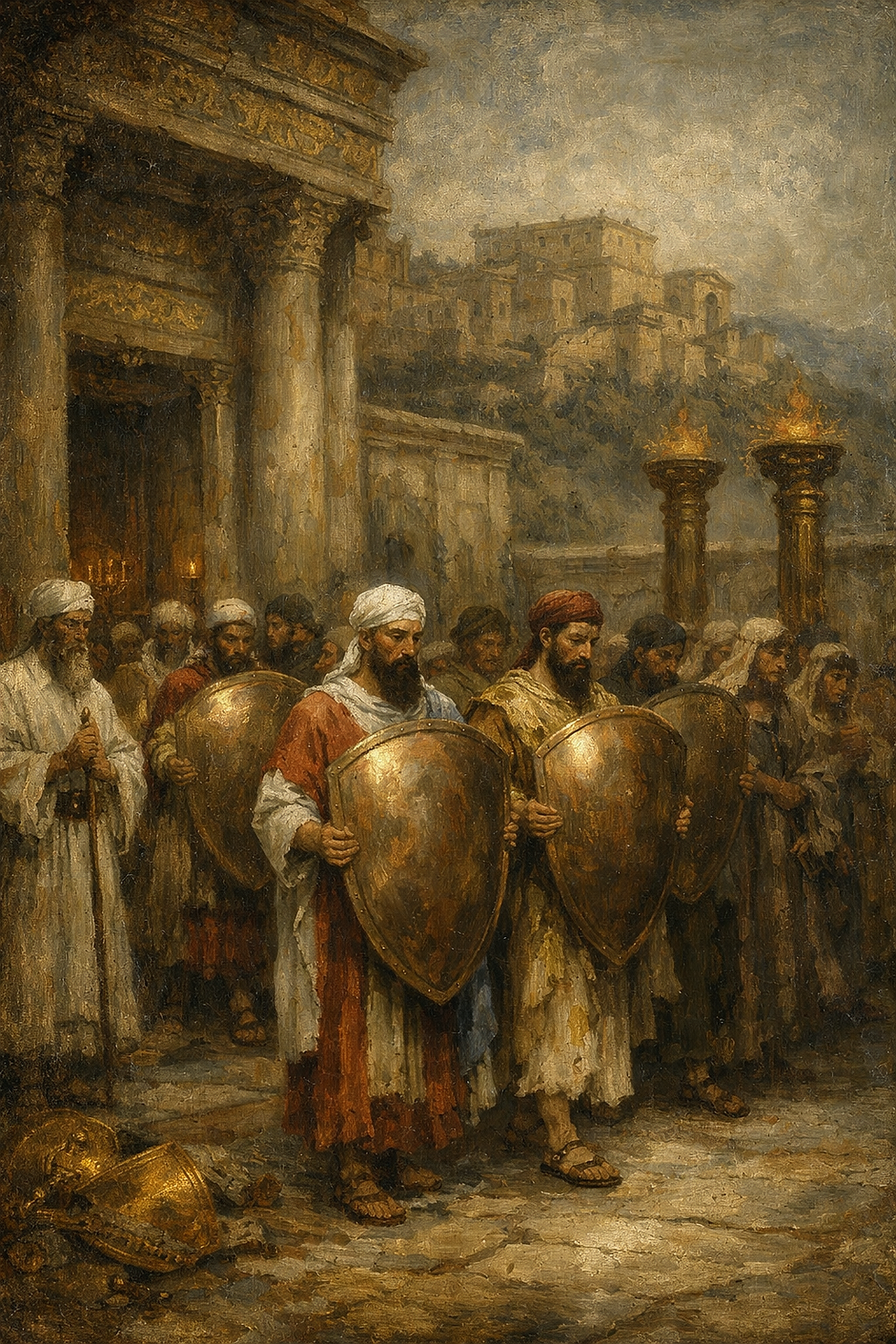
Shishak enters Jerusalem and takes the treasures of the house of the Lord and of the king’s house. He takes everything, including the gold shields Solomon had made (2 Chr 12:9; cf. 1 Kgs 10:16–17). Then Rehoboam replaces them with bronze shields.
That image is the theological center of the chapter. Gold gives way to bronze. Glory is not abolished in outward form, but diminished in substance. The procession to the temple still happens. The guards still carry shields. The routines continue. But the kingdom now moves with substitute splendor.
This is how sin often works. It does not always destroy form at once. It hollows weight while preserving appearance. Bronze can imitate gold from a distance. So can religious performance imitate devotion. The temple is still there, yet something has been stripped away.
And still the text refuses despair. “When he humbled himself the wrath of the Lord turned from him, so as not to make a complete destruction; moreover, conditions were good in Judah” (2 Chr 12:12). Not golden, but good. Not restored to Solomon’s height, but spared from utter collapse. Chronicles is pastorally honest: repentance may not recover yesterday’s splendor overnight, but it may preserve tomorrow.
When Crisis Humility Falls Short of a Set Heart (2 Chr 12:13–16)
The final verdict comes in verse 14: “He did evil, for he did not set his heart to seek the Lord.” That line explains everything. Rehoboam did humble himself in crisis, and that humility mattered. But crisis-humility is not the same as a heart steadily prepared for God.
The issue is not whether Rehoboam ever felt fear. The issue is whether he deliberately ordered his inner life toward seeking the Lord. Chronicles keeps returning to this theme. The heart must be set, prepared, directed Godward (cf. 1 Chr 22:19; 2 Chr 19:3; 30:19).
So the chapter ends in sadness, not because mercy was absent, but because mercy did not ripen into durable obedience. Rehoboam bent under pressure, but he never became a king whose life was truly centered in worship.

4.0 Theological Reflection
4.1 Seeking the Lord Is the Great Dividing Line
Chronicles measures kings not mainly by military success but by whether they seek or forsake the Lord. Rehoboam’s evil is summed up not first as failed policy, but as failed orientation of heart. Worship is never peripheral in this book. It is the center from which public life either stands or collapses.
4.2 Humility Can Delay Judgment
This chapter offers one of Chronicles’ clearest demonstrations that humility matters. The confession “The Lord is righteous” opens a door to mercy. This echoes the great promise of 2 Chronicles 7:14: when God’s people humble themselves, pray, seek, and turn, healing becomes possible. Humility does not manipulate God, but God delights to meet the lowly with restrained wrath.
4.3 Temple Loss Is a Theological Sign
The plundering of the temple is more than economic humiliation. The house where God’s name dwells is stripped because covenant life has been treated casually. The postexilic audience would have felt this deeply. They knew what it meant for glory to fade. The chapter warns them, and us, that restored worship must be guarded by more than ceremony.
4.4 Rehoboam and the True Son of David
Rehoboam is humbled because pride hollows out his faithfulness. The true Son of David walks the opposite road. He does not lose glory through disobedience; He passes through humiliation by obedience (Phil 2:6–11). Rehoboam’s kingdom is left with bronze shields. Christ builds a people in whom the glory of God returns, not by political grandeur, but by faithful self-giving, cleansing, and covenant renewal (John 2:19–21; Eph 2:19–22).
5.0 Life Application
Beware the season when success makes prayer thinner instead of deeper.
Read pressure through the lens of covenant honesty: what is God exposing at the center?
Confess plainly. Mercy often begins with the sentence, “The Lord is righteous.”
Refuse bronze-shield religion—outward continuity without inward weight.
Accept that repentance may not erase every consequence, yet it may still prevent complete ruin.
Set the heart deliberately to seek the Lord through prayer, Scripture, gathered worship, and concrete obedience.
In communities of faith, leaders must model humility publicly; pride at the top spreads drift through the whole people.
6.0 Reflection Questions
Where has present strength made you less dependent on God rather than more grateful to Him?
What “bronze shields” in your life preserve appearance while deeper glory has thinned?
Is your humility mainly reactive in crisis, or is your heart truly set to seek the Lord?
What present hardship might be teaching you the difference between God’s service and the service of lesser powers?
What would honest confession before God sound like for you this week?
7.0 Response Prayer
Lord of covenant mercy,when strength makes us careless, awaken us.When we mistake Your gifts for our own greatness, humble us.When the gold has thinned and only bronze remains,keep us from living by appearance.
Teach us to say with truth, “The Lord is righteous.”Set our hearts to seek You before crisis comes.Cleanse Your house in us.Restore reverence, obedience, and living prayer.And through the true Son of David,bring us from fading glory into lasting faithfulness. Amen.
8.0 Window into What Comes Next
The story now turns to Abijah, and the conflict sharpens around worship, priesthood, and covenant identity. If Rehoboam showed how strength can forget its source, Abijah will stand amid battle and argue that the real issue between north and south is not merely politics, but who has truly kept the worship of the Lord.
9.0 Bibliography
Dillard, Raymond B. 2 Chronicles. Word Biblical Commentary 15. Waco, TX: Word Books, 1987.
A rich exegetical treatment of the Chronicler’s literary shaping, theology, and historical presentation, especially useful for tracking the book’s recurring motifs of humility, judgment, and reform.
Japhet, Sara. I & II Chronicles: A Commentary. Old Testament Library. Louisville: Westminster John Knox, 1993. One of the most substantial modern commentaries on Chronicles, especially strong on the Chronicler’s compositional strategy, theological emphases, and relationship to Samuel–Kings.
Pratt, Richard L., Jr. I & II Chronicles: A Mentor Commentary. Fearn, Ross-shire: Mentor, 1998.
Helpful for reading Chronicles as pastoral theology for the postexilic community, with sustained attention to patterns of sin, repentance, judgment, and restoration.
Sailhamer, John. First and Second Chronicles. Everyman’s Bible Commentary. Chicago: Moody Press, 1983. A concise theological reading of Chronicles that clearly highlights the book’s themes of Davidic hope, temple centrality, covenant faithfulness, and the future-oriented shape of its retelling of history.
Williamson, H. G. M. 1 and 2 Chronicles. New Century Bible Commentary. Grand Rapids: Eerdmans, 1982. Especially valuable for literary and historical analysis, and for understanding how the Chronicler reworks inherited traditions to address the concerns of a later community.


Comments