
From Walls to Vessels: When the House of God Becomes Ready for Worship | Analysis of 2 Chronicles 4
- Pr Enos Mwakalindile
- Apr 22
- 10 min read

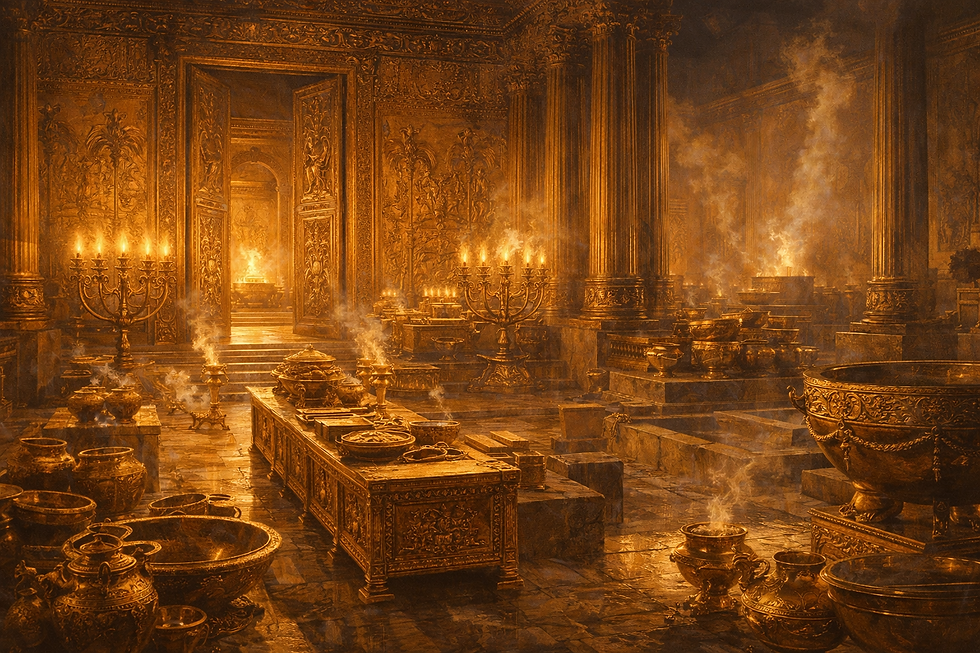
The house now stands, but stone alone cannot sing, cleanse, burn, or bless. A temple must be furnished for sacrifice, washing, light, bread, and service. So this chapter moves from architecture to availability, from grandeur to readiness, from structure to holy use. Bronze and gold become theology. Bowls, basins, lampstands, tables, and the great sea all quietly declare the same truth: the living God does not merely ask for a house to admire, but a place where a sinful people may draw near through ordered holiness, repeated cleansing, and reverent service.
1.0 Introduction
There are moments when a life looks finished from a distance but is still not prepared at the center. The walls are up. The roof is in place. The name is visible. Yet the inner room is empty, the table is bare, the lamps are dark, and no water stands ready for washing. It is possible to have structure without readiness, form without function, religious shape without living worship.
That is the quiet pressure of 2 Chronicles 4. The temple has already been built in chapter 3. Its place has been chosen, its chambers formed, its pillars raised. But a house for God must be more than standing timber and covered stone. It must be furnished for sacrifice, cleansing, illumination, and ministry.
The heart-question is this: What must be put in place if the people of God are truly to live before His presence?
This text is about a sacred structure becoming a prepared meeting place.
2.0 Historical and Literary Context
Second Chronicles 4 belongs to the Solomon section of Chronicles (2 Chronicles 1–9), where the Chronicler presents Solomon chiefly not as an empire-builder, but as the son of David who completes and orders the house of the Lord. That emphasis matters. Chronicles is not simply repeating Kings. It is retelling Israel’s past for a wounded covenant people learning how to live after failure, exile, and diminished glory. For such a people, temple details are not decorative trivia. They are lessons in how worship is sustained.
Chapter 3 gave the temple its form. Chapter 4 gives it function. The movement is deliberate. The Chronicler wants readers to see that worship requires more than sacred architecture. It requires the practical architecture of holiness: altars for atonement, water for cleansing, tables for covenant bread, lampstands for light, and vessels for the daily rhythm of priestly service.
This chapter also keeps alive one of Chronicles’ central themes: God’s presence among His people is gracious, but never casual. The temple is not a monument to national pride. It is an ordered place of approach. The details are many because holiness touches details. Worship has weight. Service has form. Nearness to God is not improvised.
And yet, even in all its beauty, this chapter quietly reveals incompleteness. The repeated vessels and repeated washings remind us that more cleansing is still needed. The light must be tended again and again. Sacrifices must continue. The temple is glorious, but it is also provisional. It points beyond itself.
3.0 Walking Through the Text
3.1 When the Altar Claims the Front of the House (2 Chronicles 4:1)
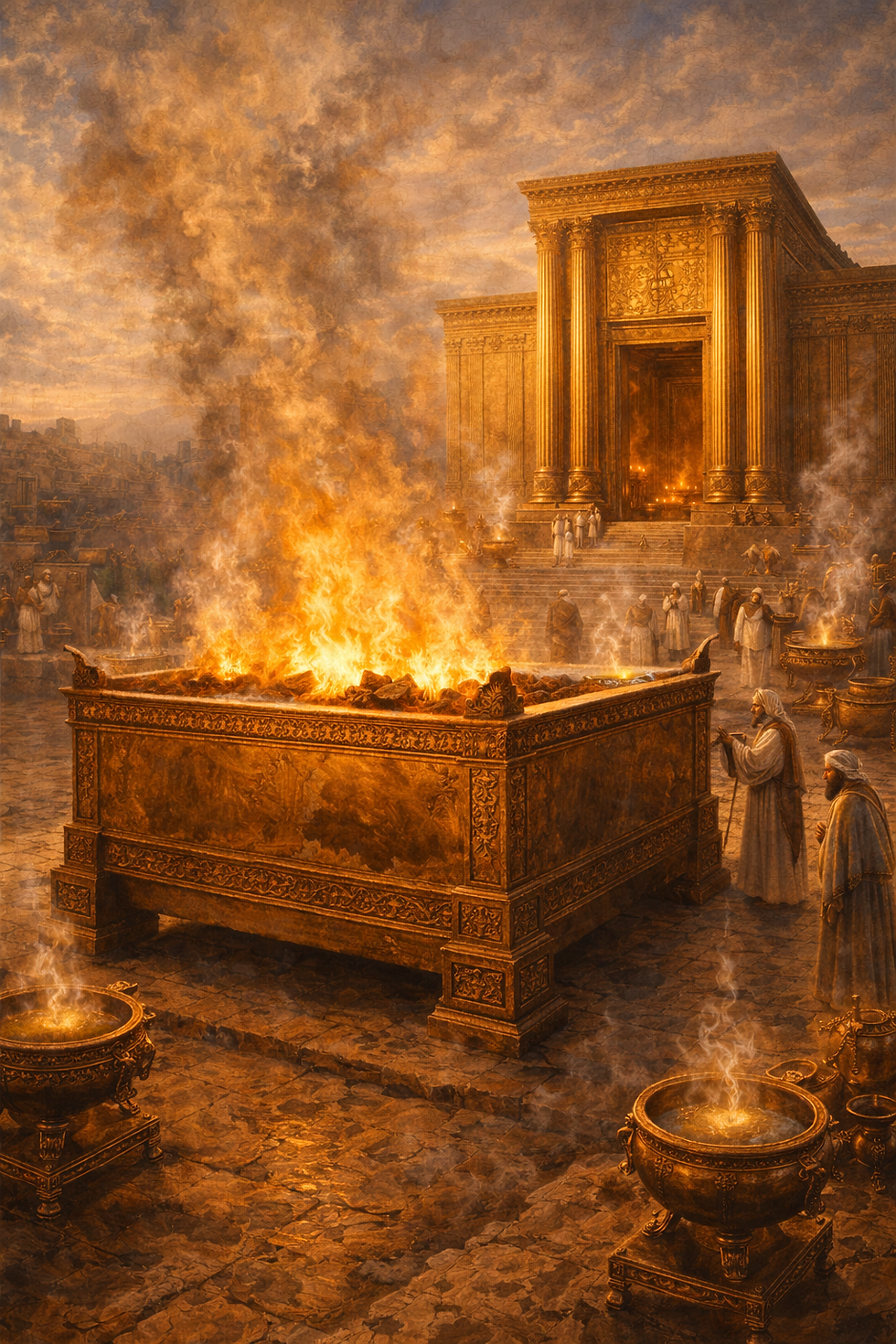
The first furnishing named is the bronze altar. That order matters. Before the chapter speaks of water, lamps, or tables, it speaks of sacrifice. The house of God begins, in practical terms, with an altar.
The altar is large, square, and elevated. It dominates the approach. The literary effect is unmistakable: access to God is not treated as a simple stroll into the sacred. The first reality confronting the worshiper is the need for atonement. The temple does not flatter human innocence. It tells the truth about sin and about the mercy of God who provides a place where sacrifice may be offered.
This fits the wider movement of Chronicles. The temple rises on Moriah, the mountain of provision. It stands at the site where David learned that judgment must be answered by mercy given from above. So it is fitting that the altar stands first. Before bread, before light, before ornament, there is blood. Before communion, there is cleansing through sacrifice.
Theologically, this is one of the chapter’s deepest notes. The way into God’s house is not built on human achievement, but on God’s provision. Worship begins where pride dies.
3.2 When Water Is Gathered for a Holy People (2 Chronicles 4:2–6)
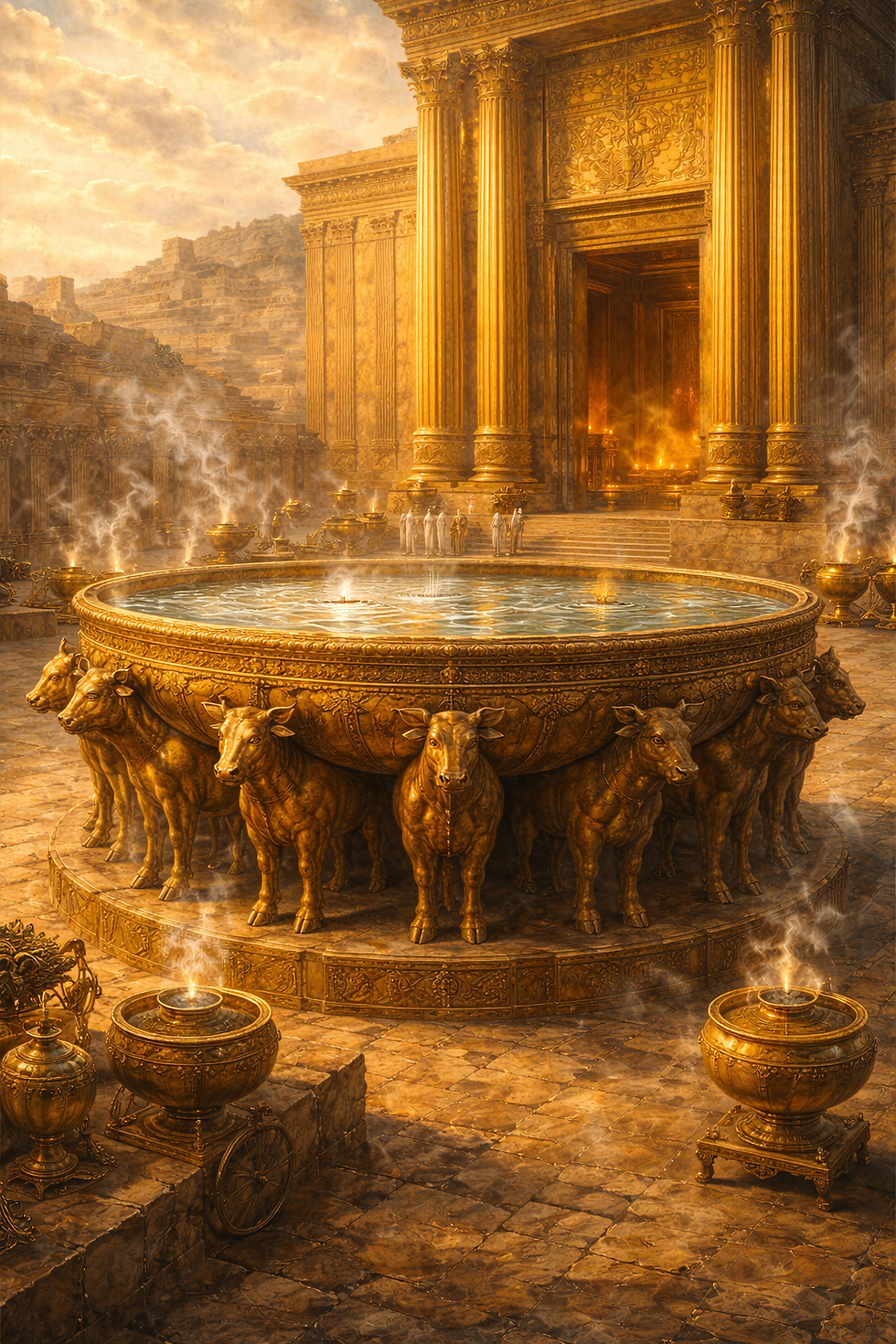
The next great feature is the “sea,” the immense bronze basin resting on twelve oxen, along with ten smaller basins. The sea is almost overwhelming in scale. It is not a decorative fountain. It is water gathered for priestly purification.
The imagery is rich. Water in Scripture often signals cleansing, life, chaos restrained, and God’s ordering power. Here the sea stands in God’s house as contained abundance. What once threatened in untamed form is now held in service of holiness. The twelve oxen beneath it likely gesture toward Israel in its covenant fullness. The whole people, as it were, support the witness that cleansing is necessary in the life of worship.
The Chronicler also notes the smaller basins used for washing what belonged to the burnt offering, while the sea is for the priests. The distinction shows that holiness is not vague. There are appointed means, appointed servants, appointed actions. Service in God’s presence requires cleansing not only in broad principle but in concrete practice.
This reveals something important about covenant life. God does not only forgive; He prepares His people to serve. Grace does not erase the need for holiness. Grace makes holiness possible.
3.3 When Lampstands and Tables Teach the Rhythm of Communion (2 Chronicles 4:7–8)
Next come the golden lampstands and the tables, arranged according to command. Here the chapter moves from sacrifice and cleansing to sustained fellowship. Light and bread belong in the sanctuary because the presence of God is not merely about pardon from guilt, but about ongoing life before Him.
The lampstands suggest illumination, guidance, and the continuing brightness of God’s presence. A temple without light would be a place of form without vision. The tables, likely associated with the bread of the Presence, speak of covenant fellowship, provision, and ongoing remembrance.
The literary pattern is beautiful. The house is furnished not only for crisis, but for constancy. Not only for sin to be addressed, but for communion to be maintained. Worship is not merely emergency repentance; it is sustained life in the presence of God.
For the Chronicler’s postexilic audience, this would have been deeply pastoral. They were not being called only to mourn past failure. They were being called to rebuild a pattern of life with God—one in which light is tended and bread is set out again. The way forward is not spectacle, but ordered faithfulness.
3.4 When Gold Reaches into the Details (2 Chronicles 4:9–22)
The chapter broadens into courts, doors, bowls, basins, forks, censers, and the many articles made by Huram-abi for the house of the Lord. The Chronicler lingers over materials, craftsmanship, and number. Some readers may feel the pace slow here, but that slowness is part of the message.
Holiness reaches into details. The work of God’s house includes what might seem ordinary or secondary: utensils, hinges, containers, tools. The court for priests and the great court for the people also matter. Worship is not an abstract experience floating above embodied life. It happens in space, movement, sequence, handling, carrying, opening, washing, burning, and serving.
One striking feature here is the repeated contrast between bronze and gold. Bronze belongs especially to the outer sphere of cleansing and sacrifice. Gold shines in the inner furnishings nearer the sanctuary’s heart. Without pressing the symbolism too far, the arrangement itself suggests ordered nearness. The temple teaches Israel to think in concentric holiness.
The mention of Huram’s craftsmanship also reminds us that skill is not spiritually trivial. Artisanship serves worship. Wisdom with the hand can become an offering to God. The temple is not made by zeal alone, but by disciplined work, measured labor, and excellence turned toward holiness.
The chapter ends by noting that Solomon made all these things in great abundance, so much that the weight of the bronze could not be determined. That line leaves a sense of overflow. The house is furnished generously because God is not poor in mercy, poor in provision, or poor in glory.
4.0 Theological Reflection
4.1 Worship Requires Atonement, Cleansing, and Sustained Communion
The order of the chapter is instructive. The altar comes first. Then water. Then light and bread. Chronicles teaches that covenant nearness rests on a pattern: sacrifice addresses guilt, washing prepares the servant, and light and bread sustain life in God’s presence.
That pattern runs through the Bible. The sinner is not first invited to perform, but to come by the way God provides. Yet the story does not stop at forgiveness. It moves toward transformed life, illumined life, nourished life. In Christian reading, these temple rhythms point beyond themselves to Christ: the true sacrifice, the giver of cleansing, the light of the world, and the bread of life.
4.2 Holiness Has Form
This chapter refuses the fantasy that spirituality is strongest when it is least embodied. The Chronicler sees no contradiction between deep devotion and ordered practice. Measurements, vessels, duties, courts, and materials all matter because God’s holiness touches the shape of communal life.
This has pastoral force. Communities often fail in two opposite ways. Some settle for empty formalism, where the vessel remains but the heart is gone. Others despise form altogether, imagining that spontaneity alone is spiritual depth. Chronicles resists both errors. Outward order is not enough, but it is not nothing. Holy love often needs holy habits.
4.3 God Cares About the Daily Architecture of Worship
The temple furnishings are not dramatic in the same way as fire from heaven or the cloud of glory, yet they are indispensable. Bowls and basins do not dazzle like visions, but without them worship falters. This is one of the chapter’s quiet gifts. God is honored not only in high moments, but in prepared spaces, clean vessels, faithful tending, and repeated service.
The same is true in the life of the people of God. The ordinary practices of prayer, confession, shared bread, ordered gathering, generous service, and careful stewardship are not beneath theology. They are the daily architecture through which communities breathe.
4.4 The Temple Is Glorious, but Still Not Final
For all its splendor, the chapter is marked by repetition. Washings continue. Sacrifices continue. Lamps must be maintained. Bread must be set out. The house is real, beautiful, and God-given, but it does not yet bring the story to completion.
That incompleteness matters in Chronicles. Solomon is great, but he is not the final son of David. The temple is glorious, but it is not the final dwelling of God with humanity. The chapter points beyond itself to the greater hope: a fuller cleansing, a fuller priesthood, a fuller light, a fuller communion. In the wider canon, this hope comes to rest in Christ, who not only ministers in the true holy place but gathers His people into a living temple of the Spirit.
5.0 Life Application
Do not mistake visible structure for spiritual readiness. Ask what “furnishings” are missing in the inner life: repentance, cleansing, light, nourishment, or ordered devotion.
Put the altar first. Begin with confession and God’s mercy rather than with performance or religious image.
Build habits of cleansing into daily discipleship. Hidden sin cannot be carried casually into sustained worship.
Tend the lamps. Guard practices that keep the mind and heart illuminated by God’s word.
Set the table. Make room for regular spiritual nourishment in community, not only emergency prayer in crisis.
Honor faithful service in small things. Bowls, doors, basins, and tools matter. Ordinary tasks can carry holy weight.
Let church life be both heartfelt and well-ordered. Resist cold formalism, but also resist careless disorder that treats holy things lightly.
6.0 Reflection Questions
What parts of life look “built” outwardly but remain unfurnished inwardly?
Where has the need for cleansing been minimized or postponed?
What practices in life tend the lamps rather than letting them dim?
How is God inviting a move from occasional crisis-driven prayer to sustained communion?
Which ordinary acts of service have been treated as too small to matter in the worshiping life of the community?
7.0 Response Prayer
Lord of altar, sea, lamp, and table,
Do not let the house of our lives stand empty before You. Furnish what has been neglected. Where there is guilt, meet us with mercy. Where there is uncleanness, wash us. Where there is dimness, light the lamps again. Where there is hunger, set before us the bread of Your presence.
Teach us to love not only the great moments of worship, but also the quiet faithfulness that makes worship possible. Cleanse our hands and search our hearts. Keep us from polished religion with no living fire. Keep us also from careless devotion that honors feeling while neglecting holiness.
Make our homes, churches, and hidden rooms ready for Your presence. Give us ordered love, humble repentance, and joy in service. And as we handle the small things entrusted to us, let us do so as those who serve in the courts of the living God.
Amen.
8.0 Window into What Comes Next
The vessels are ready. The courts are in place. The altar stands, the sea is filled, the lamps are prepared, and the tables wait. But the house is not complete until the ark comes to its resting place and the glory of the Lord fills what human hands have prepared. The next chapter will move from readiness to arrival, from furnishing to indwelling, from prepared worship to the overwhelming nearness of God.
9.0 Bibliography
Dillard, Raymond B. 2 Chronicles. Word Biblical Commentary 15. Waco, TX: Word, 1987.
Hill, Andrew E. 1 and 2 Chronicles. NIV Application Commentary. Grand Rapids: Zondervan, 2003.
Japhet, Sara. I & II Chronicles: A Commentary. Old Testament Library. Louisville: Westminster John Knox, 1993.
Sailhamer, John. First and Second Chronicles. Everyman’s Bible Commentary. Chicago: Moody Press, 1983.
Selman, Martin J. 2 Chronicles. Tyndale Old Testament Commentaries. Downers Grove, IL: InterVarsity Press, 1994.
Williamson, H. G. M. 1 and 2 Chronicles. New Century Bible Commentary. Grand Rapids: Eerdmans, 1982.


Comments