
Reopened Doors, Strengthened Walls: When Worship Holds a Fractured Kingdom Together | Analysis of 2 Chronicles 11
- Pr Enos Mwakalindile
- Apr 29
- 8 min read

The kingdom has split, the inheritance has thinned, and the old glory has cracked.Yet in the dust of division, God keeps teaching his people the same lesson: a nation is not finally held together by force, but by faithful worship.
1.0 Introduction
When something breaks, the first instinct is often to seize control. We tighten our grip. We count our losses. We look for a weapon, a plan, a wall, a faster route back to strength. That impulse runs through 2 Chronicles 11. Rehoboam has just lost most of the kingdom (2 Chr 10:16–19). Solomon’s grand house has become a divided inheritance. The question is no longer how to expand glory, but how to live after fracture.
The heart-question is this: What actually makes a people secure when judgment has already passed through the house?
This text is about a shattered kingdom becoming a preserved remnant.
The chapter answers with a surprising pattern: God restrains vengeance, Rehoboam fortifies Judah, and then the deepest strengthening comes through priests, Levites, and worshipers who gather to the place of God’s name in Jerusalem (2 Chr 11:13–17; Deut 12:5–14). Chronicles is teaching a wounded people that the way forward is not bravado, nostalgia, or spectacle. It is hearing the word of God, ordering life wisely, and centering the community again around true worship.
2.0 Historical and Literary Context
Second Chronicles 11 follows immediately after the rupture of the united monarchy. Rehoboam’s harsh answer in chapter 10 fulfills a judgment already hanging over Solomon’s house because of covenant infidelity (1 Kgs 11:9–13, 29–39; 2 Chr 10:15). The split is political, but the Chronicler wants us to see that it is also theological. The kingdom is torn because the heart has already been torn.
For the Chronicler’s postexilic audience, this matters deeply. He is not merely explaining how Israel fell apart. He is showing how a reduced people may still live faithfully after collapse. That is why 2 Chronicles 11 is so important. Judah is now smaller, weaker, and exposed, yet it still holds together the Davidic line, Jerusalem, the temple, and the priestly-levitical order. In Chronicles, those are not incidental details. They are covenant markers. They tell the reader where hope still burns.
Historically, Rehoboam’s fortified cities lie largely in Judah’s hill country and southern approaches, forming a defensive network against threats from Israel, Egypt, and the Negev corridor (2 Chr 11:5–12). Culturally, kings in the ancient Near East proved themselves by armies, storehouses, and urban defenses. Rehoboam does that. But the Chronicler quietly subordinates all of it to a deeper reality: Judah is strengthened most when the worshipers come.
3.0 Walking Through the Text
3.1 When God Stops a Brother’s War (11:1–4)
Rehoboam gathers 180,000 chosen warriors from Judah and Benjamin to recover the kingdom by force. The impulse is understandable. A king has been humiliated. A realm has been reduced. But the word of the Lord comes through Shemaiah: “You shall not go up or fight against your relatives … for this thing is from me” (2 Chr 11:4).
That final line is heavy with theology. The division is not outside divine sovereignty. Human sin is real, yet God is not absent from the wreckage. The same Lord who judged Solomon’s house now restrains Rehoboam’s rage. The king’s first faithful act in this chapter is not conquest but submission. He listens.
Chronicles often marks a ruler by whether he hears the prophetic word (cf. 2 Chr 12:6; 15:2–8; 20:14–20). Here the word of God places a boundary around human power. Not every loss may be reversed by force. Sometimes judgment must be received before healing can begin.
3.2 When Smaller Does Not Mean Forsaken (11:5–12)
Rehoboam then fortifies Judah. The city list is deliberate, not ornamental. Bethlehem, Tekoa, Hebron, Lachish, Adoraim, and others form a belt of defense. He stations commanders, stockpiles provisions, and arms the strongholds with shields and spears (2 Chr 11:11–12).
This is wise rule, but the order matters. Rehoboam builds only after he has first obeyed the divine word. The chapter does not mock prudence; it relativizes it. Walls matter. Granaries matter. Military planning matters. But none of them can become the true center. Psalm 127 says it plainly: “Unless the LORD builds the house … unless the LORD watches over the city” (Ps 127:1).
There is also something quietly pastoral here. Judah is diminished, yet not abandoned. God leaves a future to a reduced people. Chronicles is written for communities that know what it is to be smaller than they once were. This scene says reduced circumstances are not proof of divine absence.
3.3 When Worshipers Leave Convenience for Covenant (11:13–17)
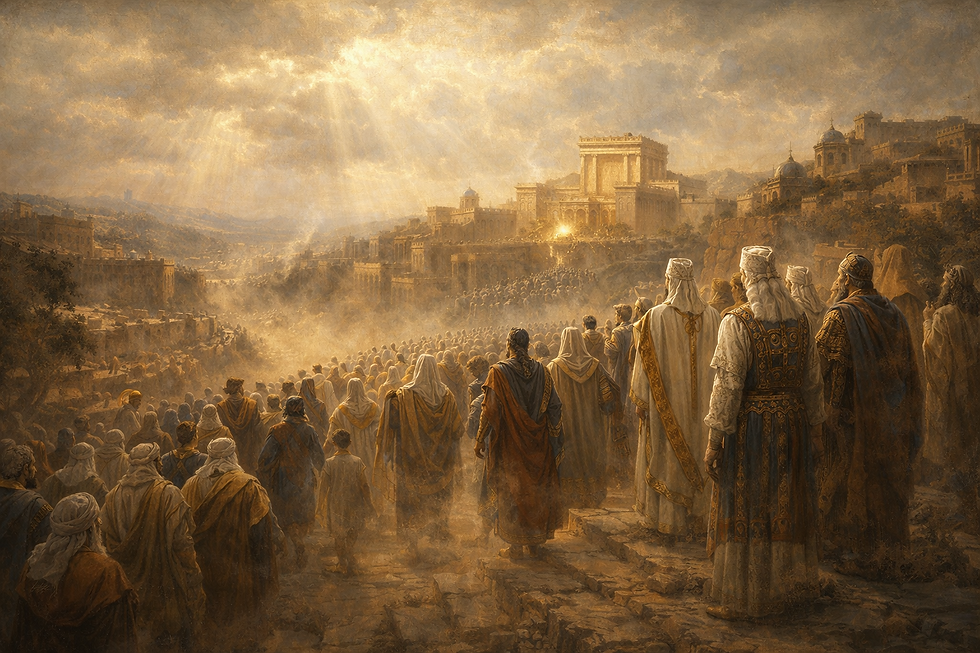
This is the center of the chapter. Priests and Levites from “all Israel” leave their lands and come to Judah and Jerusalem because Jeroboam has rejected them from serving as priests of the Lord (2 Chr 11:13–14). He has installed alternative priests for high places, goat-demons, and calves (11:15; cf. 1 Kgs 12:26–33; Lev 17:7).
Then the Chronicler widens the lens: people from every tribe, “such as set their hearts to seek the LORD God of Israel,” come after them to Jerusalem to sacrifice to the God of their fathers (2 Chr 11:16).
That phrase—set their hearts to seek the LORD—belongs to the Chronicler’s deepest vocabulary (cf. 1 Chr 22:19; 2 Chr 15:12–15; 19:3; 30:19). The issue is not mere geography. It is covenant direction. Jerusalem matters because the temple matters; the temple matters because God has chosen to place his name there (Deut 12:5; 2 Chr 6:5–6, 20). The worshipers cross the border because true worship is worth relocation.
This is also a sharp contrast with Jeroboam. In Kings, Jeroboam creates a religious system calibrated to political convenience: shrines close to home, a rival priesthood, feast-days of his own devising (1 Kgs 12:28–33). Chronicles shows the opposite movement. The faithful accept inconvenience in order to remain aligned with the living God. They lose land, status, and familiarity, but they keep covenant fidelity.
And their presence strengthens Judah for three years (2 Chr 11:17). That is a remarkable claim. Priests, Levites, and faithful worshipers are not decorative to national life. They are part of its real strength. Worship is not a side chamber in Israel’s existence. It is the furnace where covenant identity is reheated after fracture.
3.4 When Order Is Real but Incomplete (11:18–23)
The closing section turns to Rehoboam’s family arrangements: wives, sons, inheritance plans, and the promotion of Abijah (2 Chr 11:18–23). He acts shrewdly, dispersing his sons among the fortified cities and supplying them well.
The move is politically skillful, but the tone is mixed. The multiplication of wives echoes Deuteronomy’s warning about kings (Deut 17:17), and the dynastic maneuvering reminds the reader that administrative order is not the same as a fully obedient heart. That is one of Chronicles’ steady burdens: reform and compromise can live frighteningly close together.
So the chapter ends not in triumph, but in tension. Rehoboam can hear God’s word, strengthen cities, receive faithful worshipers, and still remain a compromised king. Partial obedience can produce real good, but it cannot carry messianic hope. The lamp still burns, but the room is still dim.

4.0 Theological Reflection
4.1 God’s Word Restrains Power for the Sake of Mercy
The first grace in the chapter is a prohibition. God says no to civil war. Divine mercy sometimes appears not as visible blessing, but as holy interruption. Rehoboam is saved from making the wound deeper.
4.2 Worship Is the Deep Structure of Covenant Life
The chapter’s emotional and theological center is not the military list, but the migration of priests, Levites, and seekers. That is Chronicles in miniature. A people is strongest when worship is rightly ordered around the presence of God. Temple, sacrifice, priesthood, song, and obedience belong together (2 Chr 29:25–36; 31:2–21).
4.3 Seeking the Lord Is the Great Divide
Chronicles repeatedly divides humanity not first into strong and weak, but into seekers and forsakers. To seek the Lord is not vague piety. It is embodied allegiance. It means turning toward the God who speaks, gathering where he is honored, and refusing religious substitutes.
4.4 The Chapter Trains Hope for a Greater Son of David
Rehoboam is not the answer. He can preserve, but not heal. He can fortify, but not unite. He can receive worshipers, but not become the faithful king the story still longs for. So the chapter leans forward. It prepares us for the true Son of David, who would not merely protect the house, but embody God’s presence, gather the scattered, and build a living temple from a restored people (John 2:19–21; Eph 2:19–22; 1 Pet 2:4–6).
5.0 Life Application
Receive divine restraint as mercy. Some battles should not be fought, even when pride says otherwise.
Build wisely, but do not enthrone strategy. Systems and structures cannot bear the weight of worship.
Ask what your life is really organized around: fear, convenience, appearance, or the presence of God.
Leave compromised patterns of worship, even when doing so costs comfort, familiarity, or status.
Strengthen the church by strengthening prayer, Scripture, holiness, song, and faithful leadership.
Do not mistake early reform for deep renewal. “Three years” is a warning against shallow endurance.
Bring both public and household life under God’s rule. Private ambition can quietly corrode public faithfulness.
6.0 Reflection Questions
What broken situation in your life is tempting you to reach first for force rather than obedience?
Where have walls and strategies begun to function as substitutes for trust in God?
What false convenience in worship or discipleship may need to be left behind?
In what concrete ways are you setting your heart to seek the Lord?
What would it look like for your household or church to be strengthened from the center outward?
7.0 Response Prayer
Lord of the remnant,
when pride would send us to war, teach us to hear Your restraining voice.
When fear would make us trust in walls alone, remind us that no city stands without Your mercy.
Set our hearts to seek You.
Pull us away from every altar built for convenience.
Gather us again around Your presence, Your word, Your holiness, and Your mercy.
Where we are diminished, do not abandon us.
Where we are divided, reorder us.
Where we are compromised, cleanse us.
Keep Your lamp burning among Your people.
Through the greater Son of David,
who gathers the scattered and builds a living house for Your name. Amen.
8.0 Window into What Comes Next
Judah has been steadied, but not made whole. The walls are stronger. The worshipers have gathered. Yet the heart of the king remains untested at depth. In the next chapter, strength will become its own danger. The issue will no longer be survival after division, but whether prosperity can remain humble beneath the hand of God.
9.0 Annotated Bibliography
Dillard, Raymond B. 2 Chronicles. Word Biblical Commentary 15. Waco, TX: Word, 1987.A careful exegetical commentary, especially useful on the Chronicler’s theology of retribution, temple-centered worship, and the literary shaping of Judah’s kings.
Japhet, Sara. I and II Chronicles: A Commentary. Old Testament Library. Louisville: Westminster John Knox, 1993.Rich on the Chronicler’s rhetoric, ideology, and postexilic perspective. Especially valuable for understanding how Chronicles reshapes Samuel–Kings for a later community.
Klein, Ralph W. 2 Chronicles: A Commentary. Hermeneia. Minneapolis: Fortress, 2012.Strong on historical setting, textual detail, and the political-religious world behind the division of the kingdom and the Judah-focused narrative.
Sailhamer, John. First and Second Chronicles. Chicago: Moody Press, 1983.Helpful for seeing the large theological movement of Chronicles: Davidic hope, temple centrality, covenant memory, and the forward pull toward restoration. See especially the discussion of Rehoboam and the early divided monarchy.
Selman, Martin J. 2 Chronicles. Tyndale Old Testament Commentaries. Downers Grove, IL: InterVarsity Press, 1994.Clear, concise, and pastorally alert. Useful for tracing themes of seeking the Lord, true worship, and the Chronicler’s concern for reform and relapse.
Williamson, H. G. M. 1 and 2 Chronicles. New Century Bible Commentary. Grand Rapids: Eerdmans, 1982.A reliable guide to literary structure, historical background, and the theological function of lists, royal summaries, and cultic material in Chronicles.


Comments