
2 Chronicles 16 — When Strength Forgets to Kneel: The Cracked Wall of a Restless Heart
- Pr Enos Mwakalindile
- 2 days ago
- 8 min read

Some walls are broken by armies. Others crack from within. Asa once cried, “We rely on you” (2 Chr 14:11). Now he leans on silver, treaties, and visible strength. The chapter is not mainly about diplomacy but about drift: the slow turning of a heart from prayer to pressure, from trust to management. A kingdom may still look stable while its center has begun to split. This is 2 Chronicles 16.

1.0 Introduction
There is a danger that comes not only in the first days of fear, but after long years of blessing. A person can remember old mercies and still stop leaning on the God who gave them. Yesterday’s testimony can become today’s substitute for dependence.
That is the sorrow of 2 Chronicles 16. Asa had known reform, rest, prophetic encouragement, and miraculous deliverance (2 Chr 14:2–15; 15:1–19). But when pressure returns, he does not pray as he once did. He does not say, “We rely on you” (2 Chr 14:11). He buys help.
The heart-question is painfully clear: What do we reach for when old fear comes back?
This text is about strength becoming self-reliance.
2.0 Historical and Literary Context
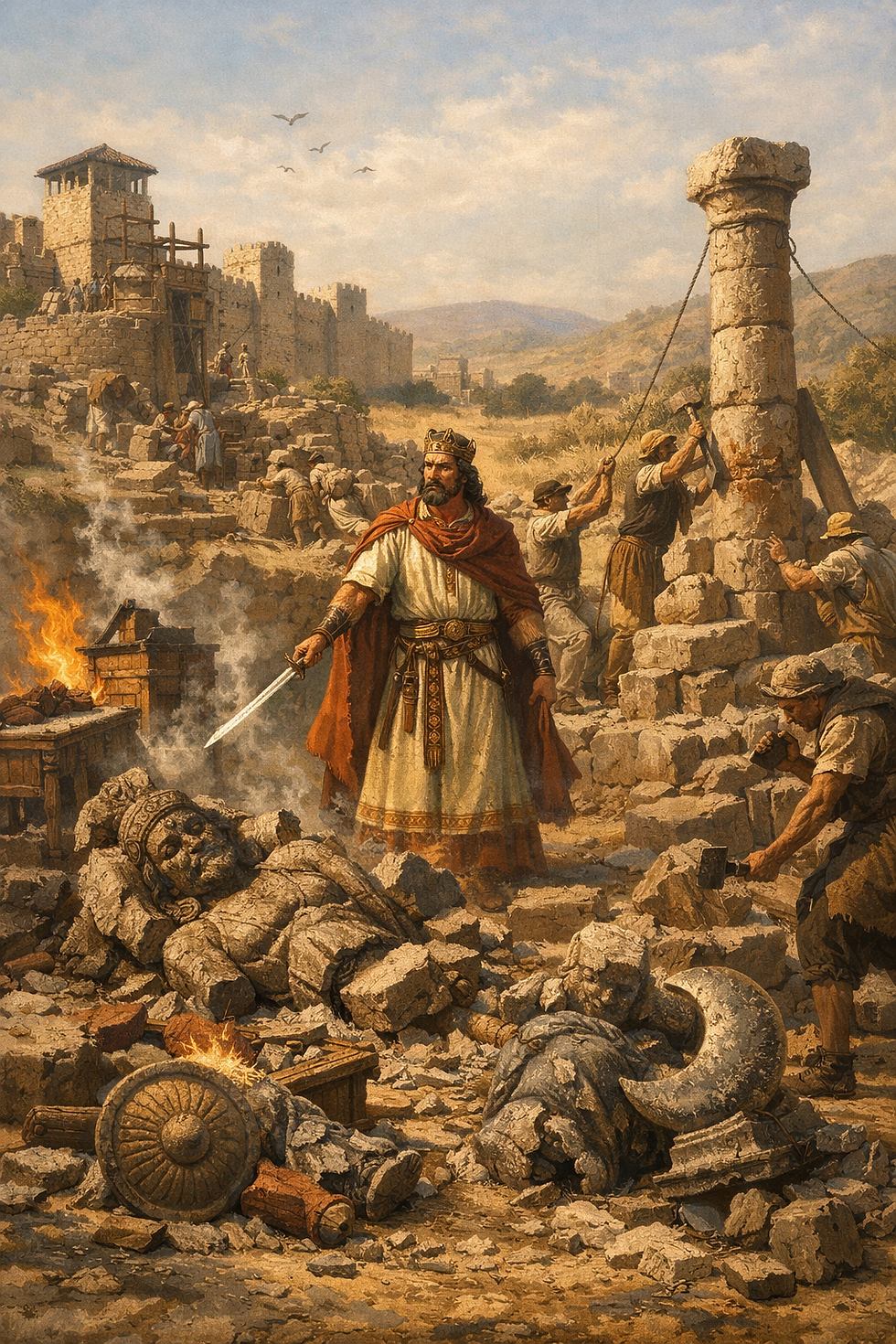
Second Chronicles 16 closes Asa’s reign. Earlier, the Chronicler presented Asa as a reforming king: he removed idols, commanded Judah to seek the Lord, and led the people into covenant renewal (2 Chr 14:3–5; 15:8–15). His story once sounded like spring after drought.
But Chronicles is written for a community living after collapse, a people learning that reform and relapse often stand close together. So Asa’s last chapter matters. It warns that a king may begin in dependence and end in resistance. The issue is not merely whether a ruler wins battles, but whether he seeks the Lord—one of the Chronicler’s great measuring lines (2 Chr 15:2, 4, 12, 15; 16:12).
This chapter also echoes a larger biblical tension. Israel’s king was not to multiply security on pagan terms, but to live under God’s word (Deut 17:16–20). Judah’s life was meant to flow from covenant trust, not from imitation of the nations. Asa’s failure, then, is not just tactical. It is theological. He begins to handle covenant life as though survival rests in calculation rather than in the Lord who “shows himself strong” for the wholehearted (2 Chr 16:9).
3.0 Walking Through 2 Chronicles 16
3.1 When Fear Borrows Aram’s Sword — 16:1–6
Baasha king of Israel fortifies Ramah to choke Judah’s movement (2 Chr 16:1). The threat is real. Trade, travel, and political breathing room are tightening.
Asa responds by taking “silver and gold from the treasures of the house of the LORD and the king’s house” and sending them to Ben-hadad king of Aram (2 Chr 16:2). The plan works outwardly. Ben-hadad strikes northern towns; Baasha stops building; Asa uses the materials from Ramah to fortify Geba and Mizpah (2 Chr 16:4–6).
That visible success is part of the chapter’s sting.
Chronicles wants us to remember Asa’s earlier prayer: “O LORD, there is none like you to help, between the mighty and the weak. Help us, O LORD our God, for we rely on you” (2 Chr 14:11). Then Asa faced a larger army and cried upward. Here he faces a smaller crisis and reaches sideways. The contrast is deliberate.
The sin is not diplomacy in the abstract. The sin is misplaced reliance. Hanani will name it plainly: “Because you relied on the king of Syria, and did not rely on the LORD your God” (2 Chr 16:7). Asa now treats what is seen as more secure than the God who had already delivered him.
The detail about temple treasure deepens the wound. What should have been the center of prayer becomes the funding source for unbelief. The house that signified God’s presence is emptied to purchase human protection. In biblical terms, this is close to the old temptation to trust in “horses and chariots” rather than the name of the Lord (Ps 20:7; Isa 31:1).
3.2 When the Prophet Interprets the Victory — 16:7–9
Hanani the seer comes and tells Asa the truth beneath the event. Asa has solved the immediate problem, but he has missed a greater deliverance: “the army of the king of Syria has escaped you” (2 Chr 16:7). He won a small relief and lost a larger horizon.
Then Hanani reaches back into memory: “Were not the Ethiopians and the Libyans a huge army with very many chariots and horsemen? Yet because you relied on the LORD, he gave them into your hand” (2 Chr 16:8). This is classic Chronicles theology. Memory is moral. Past grace is not decoration; it is a summons to present trust.
Then comes the chapter’s blazing center: “For the eyes of the LORD run to and fro throughout the whole earth, to give strong support to those whose heart is blameless toward him” (2 Chr 16:9, ESV). The Lord is not distant, passive, or slow to notice. He is actively attentive, searching not for impressive strength but for undivided hearts.
This line resonates across Scripture. The God who “searches all hearts” (1 Chr 28:9) is not looking for polished performance, but for covenant loyalty. The same truth stands behind Jeremiah’s warning, “Cursed is the man who trusts in man” and “blessed is the man who trusts in the LORD” (Jer 17:5, 7). Asa’s tragedy is not merely that he feared; it is that he relocated his trust.
Hanani’s conclusion is severe: “You have done foolishly in this, for from now on you will have wars” (2 Chr 16:9). Asa sought peace through alliance and secured unrest instead. The shortcut becomes a seed of future trouble.

3.3 When Rebuke Becomes an Enemy — 16:10
Asa does not repent. He rages. He puts Hanani in the stocks and oppresses some of the people at the same time (2 Chr 16:10).
The movement is tragic but recognizable. A heart that resists God’s word soon turns hard toward neighbor. The king who once gathered the people into covenant renewal (2 Chr 15:9–15) now crushes the prophetic voice and wounds the community.
Chronicles repeatedly measures kings by how they respond to the word of God. Humility opens the door to mercy; resistance ripens judgment (2 Chr 7:14; 12:6–7; 15:2; 30:9). Asa fails precisely here. He does not humble himself. He treats correction as injury.
This is why the chapter is about more than private spirituality. Worship and justice are bound together. To reject the searching word of God is eventually to deform public life. A ruler who will not be corrected becomes dangerous to those under his power.
3.4 When the Feet Fail — 16:11–14
The last scene turns from politics to the body. Asa develops a severe disease in his feet (2 Chr 16:12). In Scripture, feet often suggest walking, direction, and stance (Ps 1:1; Prov 4:26–27). The king who would not stand in trust now cannot stand with strength.
But the sharpest word is not about the disease itself: “Yet even in his disease he did not seek the LORD, but sought help from physicians” (2 Chr 16:12). The point is not that medicine is forbidden. Scripture elsewhere can speak positively about healing means and care. The issue here is again theological: even suffering does not bring Asa back to seeking God. The phrase “did not seek the LORD” deliberately echoes the chapter’s central concern.
So Asa dies. He is buried with royal honor, spices, and great burning (2 Chr 16:14). There is dignity in the funeral, but the Chronicler will not let ceremony hide the fracture. The man who once sought the Lord ends with unresolved self-reliance.

4.0 Theological Reflection
4.1 Seeking the Lord Is the Real Measure of a Life
Chronicles asks again and again: does this king seek the Lord? That question exposes the heart beneath policy, worship, and crisis. Asa’s fall shows that decline often begins before scandal appears. It begins when trust quietly moves.
4.2 God’s Eyes Search for Whole Hearts, Not Impressive Resources
Second Chronicles 16:9 is one of the book’s most important theological statements. God is eager to strengthen the loyal-hearted. Divine help is not scarce. The problem is not divine reluctance but human dividedness.
4.3 False Worship and False Trust Belong Together
Asa’s misuse of temple treasure reveals something deep: worship cannot remain central if trust has already shifted. The house of God becomes useful rather than holy. What was meant for communion becomes material for self-protection.
4.4 Asa Creates a Longing for a Better King
Asa begins well and ends poorly. Like the other kings, he cannot carry the promise fully. Chronicles keeps teaching wounded readers to long for the true Son of David—the king who will never trade obedience for security, who will receive the Father’s word without resistance, and who will embody in himself the meeting place between God and his people (cf. John 2:19–21).
5.0 Life Application
Remember former deliverances on purpose. Let past mercies become present arguments for trust (2 Chr 16:8).
Ask where visible solutions have begun to replace prayerful dependence.
Refuse to measure faithfulness only by results. Some plans work and still wound the soul.
Welcome rebuke that tells the truth. A hard word may be mercy sent to prevent a harder fall.
Do not use what belongs to God to finance anxious self-protection.
Let pain soften the heart rather than seal it shut.
Rebuild the hidden altar first. The deepest crisis in this chapter is not at Ramah but in Asa’s heart.
6.0 Reflection Questions
Where am I relying on what can be managed instead of on the Lord?
What past deliverance have I admired in memory but neglected in practice?
How do I respond when truth exposes compromise?
What resources meant for worship or obedience are being redirected toward fear?
Has suffering made me seek God more deeply, or only tighten control?
7.0 Response Prayer
Lord whose eyes search the whole earth,
find us before we hide behind our own walls.Where fear has become strategy,where pressure has replaced prayer,where we have leaned on visible strength,call us back.
Give us the whole heart you love to strengthen.Teach us to remember your former mercies rightly.Keep us from silencing truth when it wounds our pride.When our feet fail, when our plans fail,when our strength thins,let weakness become a doorway back to you.
Through the true Son of David,make us steadfast, humble, and ready to seek you again.Amen.
8.0 Window into What Comes Next
Asa’s reign ends in ache, but the story does not end there. Another son of David steps forward. Jehoshaphat will rise in the next chapter, and with him the question returns: can Judah learn again to stand where Asa ceased to stand—under the word of the Lord, with trust stronger than fear?
9.0 Annotated Bibliography
Dillard, Raymond B. 2 Chronicles. Word Biblical Commentary 15. Waco, TX: Word Books, 1987. A careful exegetical commentary, especially helpful on the Chronicler’s literary shaping of Asa’s reign and the theological force of 16:9.
Japhet, Sara. I & II Chronicles: A Commentary. Old Testament Library. Louisville: Westminster John Knox, 1993. Rich on the Chronicler’s rhetoric, structure, and postexilic theological aims, especially the motifs of seeking, judgment, and covenant memory.
Knoppers, Gary N. I Chronicles 10–29; II Chronicles 1–36. Anchor Yale Bible Reference Library. New Haven, CT: Yale University Press, 2004. Strong on historical background, textual detail, and the way Chronicles retells Kings with distinctive theological intent.
McConville, J. Gordon. 1 and 2 Chronicles. Daily Study Bible. Louisville: Westminster John Knox, 1984. Concise and pastorally alert, useful for tracing the moral and covenant logic of Asa’s decline.
Sailhamer, John. First and Second Chronicles. Everyman’s Bible Commentary. Chicago: Moody Press, 1983. Particularly useful for the book’s larger theological movement—Davidic hope, temple centrality, covenant faithfulness, and the call to trust and obey.
Selman, Martin J. 2 Chronicles. Tyndale Old Testament Commentaries. Downers Grove, IL: InterVarsity Press, 1994. Insightful on Chronicles as theological history for a restored yet fragile community, with good attention to worship and reform motifs.


Comments