
Analysis of 1 Chronicles 28: When the Blueprint Passes Hands - How God Builds His House Through Wholehearted Obedience
- Pr Enos Mwakalindile
- Apr 17
- 8 min read

Updated: Apr 17
Some chapters begin before a stone is laid. The gold is not yet weighed into place. The singers have not yet filled the courts. But already the future is being built. An old king stands in the fading light and places more than plans into younger hands. He gives a calling, a pattern, a warning, and a promise. In 1 Chronicles 28, the blueprint passes hands—but the deeper question is whether the heart will bow before the God who searches it.
1.0 Introduction
We often know how to build what people can see while neglecting what only God can measure. We can organize ministries, raise structures, gather teams, and shape public momentum while the inner life grows thin. We can lift beams and still lose the heart.
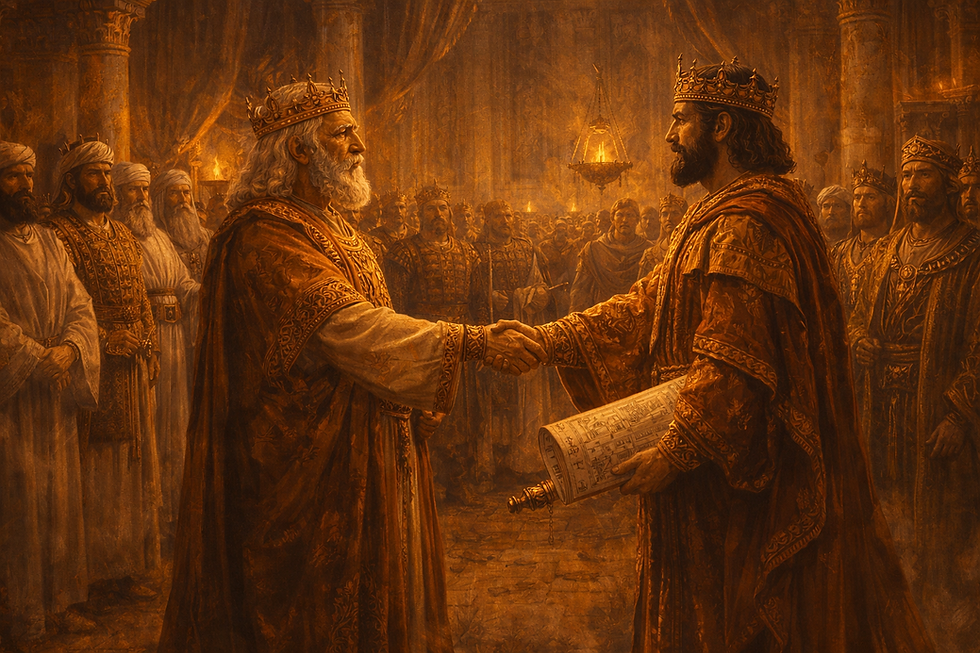
That is the searching mercy of 1 Chronicles 28. David is near the end. He cannot build the temple, though it had long been in his heart to do so (1 Chr 17:1–4; 22:6–8; 28:2–3). Yet he can still gather Israel, declare God’s choice, hand over the pattern, and charge Solomon to serve the Lord with a whole heart (28:1, 9).
The heart-question of the chapter is simple and piercing: How can a holy work be built without becoming a hollow work?
This text is about public calling becoming wholehearted obedience.
For the Chronicler’s post-disaster audience, this mattered deeply. They were a people living after collapse, learning again how covenant life might be rebuilt. So the chapter teaches that the future of God’s people is not secured by memory alone, but by revealed worship, humble succession, and hearts that seek the Lord (Deut 4:29; 2 Chr 15:2).
2.0 Historical and Literary Context
First Chronicles 28 stands near the climax of the Davidic section of the book (1 Chr 10–29). In Chronicles, David is remembered not mainly as conqueror, but as temple-preparing king, worship-ordering king, and covenant witness whose reign bends toward the house of God (1 Chr 22–27).
This chapter gathers those threads into one public scene. David summons the national leadership, identifies Solomon as the chosen son, and hands over the temple pattern (28:1, 5, 11). The effect is theological as much as political. The kingdom is not self-made. The temple is not a royal vanity project. God chooses, God assigns, and God gives the pattern.
That emphasis is important in Chronicles. The book retells Israel’s past for a community learning how to live after judgment. It is not content to explain why the nation fell. It also teaches how a wounded people may remember, worship, humble themselves, and hope again. Here the Chronicler shows that covenant continuity depends on more than inheritance by blood; it requires fidelity of heart, obedience to divine instruction, and a shared commitment to the house of the Lord.
3.0 Walking Through 1 Chronicles 28
3.1 When the Kingdom Is Gathered Before God (28:1–8)
David gathers “all the officials of Israel”—tribal leaders, military commanders, palace stewards, mighty men, and royal sons. This is covenantal assembly, not private family transition. The future of Israel is being spoken before witnesses.
David declares what had been in his heart: to build a “house of rest” for the ark, the covenant footstool of God (28:2; Ps 132:7–8, 13–14). The temple is not presented as mere architecture. It is the earthly center of worship, prayer, sacrifice, holiness, and divine kingship.
Yet David also confesses the divine no. He desired to build, but God forbade him because he was a man of war who had shed blood (28:3; 22:8). Chronicles does not shame David’s vocation; it distinguishes it. David prepares. Solomon builds. One generation fights to secure rest; another builds in that rest (1 Kgs 5:3–5). Holy succession requires humility enough to receive a task and humility enough to relinquish one.
Then David traces the line of divine choice: Judah, Jesse, David, and now Solomon (28:4–5; Gen 49:10; 2 Sam 7:12–13). The kingdom does not rise from instinct, seniority, or political force. It stands on election and promise. David’s language repeatedly presses this point: “the LORD God of Israel chose me” (28:4), and “he has chosen Solomon my son” (28:5).
The section ends with an exhortation to “all Israel” to keep the commandments of the Lord, so that the land may be possessed and passed on (28:8; Deut 6:1–3). In Chronicles, temple, land, and obedience belong together. Worship cannot be severed from covenant faithfulness.
3.2 When the Heart Is Put Under Searchlight (28:9–10)
Now the speech narrows from nation to son. David says, “Know the God of your father, and serve him with a whole heart and with a willing mind” (28:9). The center of the chapter is not technique but relationship. Solomon must inherit more than a throne. He must know the Lord.
The command echoes the wider covenant story. Israel was called to love God with all the heart (Deut 6:5), and David himself had learned that God looks beneath appearance into the inner person (1 Sam 16:7). So David adds a searching reason: “the LORD searches all hearts and understands every plan and thought” (28:9; Ps 139:1–4; Jer 17:10). The temple may be built in public, but obedience is first tested in secret.
Then comes one of Chronicles’ great covenant formulas: “If you seek him, he will be found by you, but if you forsake him, he will cast you off” (28:9; 2 Chr 15:2; 24:20; 34:27). Seeking the Lord in Chronicles is not vague spirituality. It means orienting king, people, worship, and life around God’s presence and word. Forsaking Him means drift toward divided loyalty and eventual ruin.
David therefore charges Solomon: “Be strong and do it” (28:10). Strength here is not bravado. It is obedience under the gaze of God.
3.3 When the Pattern Comes from the Hand of the Lord (28:11–19)
David then gives Solomon the pattern for the temple, its chambers, treasuries, inner rooms, and furnishings, along with the divisions of priests and Levites and the weights for gold and silver vessels (28:11–18). The chapter slows down over detail because holy worship is not casual.
The language reaches back to the tabernacle traditions. Just as Moses received the pattern for the sanctuary from God (Exod 25:9, 40; 26:30; Num 8:4), David says the pattern was made clear “in writing from the hand of the LORD” (28:19). The point is profound: the temple is not finally an act of royal imagination. It is ordered response to divine revelation.
This is why the Chronicler lingers over Levites, priests, treasuries, vessels, and service. Worship is embodied, communal, disciplined, and guarded. Beauty matters, but beauty is not free-floating. Nearness to God comes with order, boundaries, and appointed service (1 Chr 23–27; 2 Chr 29:25).
David’s leadership also shines here. He does not hoard the pattern. He passes it on. Faithful leadership is not merely performing a calling; it is transmitting it.
3.4 When Courage Must Carry the Work Forward (28:20–21)
David’s final word to Solomon gathers command and comfort: “Be strong and courageous and do it. Do not be afraid and do not be dismayed, for the LORD God, even my God, is with you” (28:20). The wording recalls Moses and Joshua at moments of covenant transition (Deut 31:7–8; Josh 1:6–9).
The phrase “my God” is tender and weighty. David is not handing Solomon a theory of providence. He is handing him testimony. The God who kept covenant with David will not abandon Solomon until the work is finished (28:20).
Nor will Solomon stand alone. Priests, Levites, skilled craftsmen, and willing leaders are present and appointed (28:21). God’s presence does not cancel human participation. Grace organizes people for holy work.
4.0 Theological Reflection
4.1 God’s House Begins with God’s Choice
The chapter insists on divine initiative. God chooses David, Solomon, Jerusalem, and the temple task (28:4–6). The same pattern marks the wider biblical story: Abraham is chosen (Gen 12:1–3), Israel is chosen (Deut 7:6–8), David is chosen (Ps 78:70–72), and the promised king is upheld by God’s own purpose (Isa 42:1). Grace stands beneath the whole structure.
4.2 The House and the Heart Must Stay Together
At the center of temple planning stands the truth that the Lord searches the heart (28:9). This protects Chronicles from mere ritualism. The same Scriptures that command worship also expose empty worship (Isa 1:11–17; Amos 5:21–24). God desires truth in the inward being (Ps 51:6). The house matters, but it cannot substitute for holiness.
4.3 True Worship Is Ordered by Revelation
David receives the pattern from the hand of the Lord (28:19), echoing Moses and the wilderness sanctuary. This means worship is not self-invented access to God. It is grateful, obedient nearness shaped by His word. Scripture, holiness, beauty, and service belong together.
4.4 David’s Transfer Points Beyond David and Solomon
David prepares but cannot build. Solomon builds but will not finally embody unbroken obedience. The chapter therefore opens a larger horizon. It makes us long for a Son of David who knows the Father perfectly, does His will fully, and becomes the true meeting place between God and humanity. The New Testament names that hope in Christ, the greater temple (John 2:19–21), the true son (Matt 12:6; Heb 3:1–6), and the cornerstone of a living house built from His people (Eph 2:19–22; 1 Pet 2:4–6).
5.0 Life Application
Ask whether the visible work of your life is being carried by a hidden life that truly seeks God (28:9; Matt 6:6).
Accept that obedience may include preparing a work you will not finish yourself. Faithfulness is not diminished by incompletion (28:3; Heb 11:13).
Let Scripture, not taste alone, shape your worship, leadership, and use of power (28:19; Col 3:16–17).
Build succession into your ministry. Hand over patterns, wisdom, and responsibility before your voice is gone.
Refuse the split between outward service and inward surrender. God still searches motives, plans, and thoughts.
Take courage where God has assigned you. Fear often appears where holy work is closest to becoming real (28:20; Josh 1:9).
6.0 Reflection Questions
What am I trying to build right now, and what does God see in the heart beneath it?
Where have I confused noble desire with actual divine assignment?
Is my worship more shaped by God’s word or by my preferences?
What responsibility do I need to pass on rather than clutch tightly?
In what area is the Lord calling me to be strong and do it?
7.0 Response Prayer
O Lord of the house and the heart,
you search what we conceal and know what we are becoming.Save us from building sacred things with divided souls.Teach us to know you, seek you, and serve you with a whole heart.
Where we must prepare, make us humble.Where we must continue another’s work, make us faithful.Where we must act, make us strong and unafraid.
Let your word be our pattern,your presence be our courage,and your mercy be the lamp that does not go out.Build us in your Son into a living house of prayer, holiness, and praise.Amen.
8.0 Window into What Comes Next
The next chapter moves from pattern to offering. The blueprint has passed hands; now treasure, willingness, and public joy must answer it. David will show that the house of God is not built by plans alone, but by hearts that gladly return to God what was always His.
9.0 Bibliography
Braun, Roddy L., and Raymond B. Dillard. 1 Chronicles. Word Biblical Commentary 14. Waco, TX: Word, 1986. Helpful on structure, literary flow, and the temple-centered shape of the Chronicler’s David narrative.
Japhet, Sara. I & II Chronicles: A Commentary. Old Testament Library. Louisville: Westminster John Knox, 1993. Especially valuable for the Chronicler’s theology, rhetoric, and postexilic perspective.
Klein, Ralph W. 1 Chronicles: A Commentary. Hermeneia. Minneapolis: Fortress, 2006. Strong on historical detail, textual issues, and the public-political force of David’s assembly speech.
Knoppers, Gary N. I Chronicles 10–29: A New Translation with Introduction and Commentary. Anchor Bible 12A. New York: Doubleday, 2004. Rich on intertextual links, royal ideology, and the theological weight of temple preparation.
Sailhamer, John. First and Second Chronicles. Everyman’s Bible Commentary. Chicago: Moody, 1983. Clear and accessible, with useful synthesis for the book’s canonical and devotional movement.
Williamson, H. G. M. 1 and 2 Chronicles. New Century Bible Commentary. Grand Rapids: Eerdmans, 1982. A steady guide to the Chronicler’s editorial aims and the chapter’s role within the wider argument of Chronicles.


Comments